
If you're collecting job applications or event registrations online, you've probably hit the same wall. Either you're overpaying for a tool like Typeform or JotForm, or you're cobbling together a Google Form that looks unprofessional and gives you zero control over where your data goes.
In this article, I'll walk through the best form backends for job applications and event registrations in 2026, covering price, features, file upload support, and which one is right for your use case.
Why the Right Form Backend Matters for Applications and Registrations
A contact form getting 10 submissions a month is simple. A job application form getting 500 submissions a month is a different problem entirely.
You need:
File uploads: Candidates submit resumes, cover letters, and portfolios.
High submission limits: Volume spikes during hiring seasons and event launches.
Multiple email recipients: HR managers, department heads, and coordinators all need copies.
CSV export: You need to review applications in a spreadsheet, not a dashboard.
Auto-responder emails: Candidates and registrants expect a confirmation email immediately.
Most form tools handle casual contact forms well. Very few handle high-volume, file-heavy, team-oriented workflows without charging you $50 to $100 per month for the privilege.
1. Formgrid: Form Builder + Form Backend With File Uploads
Best for: Teams that need file uploads, high submission volume, and email notifications without paying Typeform prices.
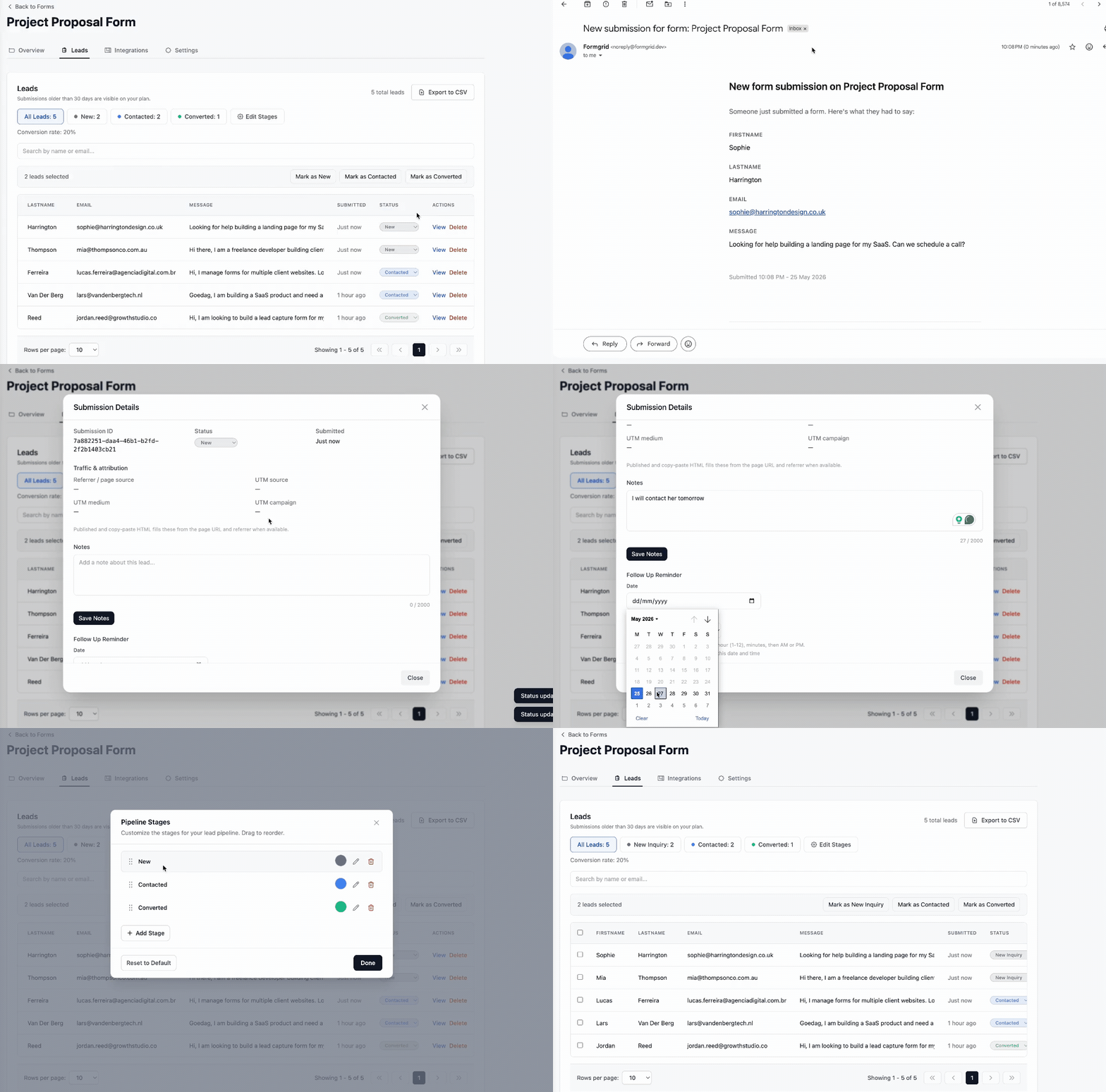
Formgrid does something most form tools don't: it combines a drag-and-drop form builder with a proper form backend endpoint. You can build a job application form with a resume upload field, share the link directly on WhatsApp or LinkedIn, and have every submission land in your inbox with the attached file included.
<!-- Already have a careers page? Point your existing form to Formgrid -->
<form action="https://formgrid.dev/api/f/your-form-id" method="POST" enctype="multipart/form-data">
  <input type="text" name="name" placeholder="Full Name" required />
  <input type="email" name="email" placeholder="Email Address" required />
  <input type="file" name="resume" accept=".pdf,.docx" />
  <button type="submit">Submit Application</button>
</form>
Key features:
Form builder: Drag-and-drop with a shareable link ready instantly.
HTML endpoint: Works with any static site or existing careers page.
File uploads: Up to 1GB per file (resumes, portfolios, cover letters).
Multiple recipients: Notify HR, hiring managers, and department heads simultaneously.
Auto-responder emails: Send instant confirmation emails to applicants and registrants.
Custom email templates: Fully branded notification emails.
CSV export: Download all submissions anytime.
Spam protection: CAPTCHA, honeypot, and rate limiting built in.
Self-hostable: Run it on your own infrastructure with Docker.
Open source: 100% MIT licensed and auditable on GitHub.
GDPR friendly: No tracking, no data selling.
Pricing:
| Plan | Price | Submissions |
|---|---|---|
| Free | $0/month | 50/month |
| Premium | $12/month | 1,000/month |
| Business | $29/month | 15,000/month |
The bottom line: For a hiring round getting 200 to 500 applications, the Premium plan at $12/month covers you. For large events or ongoing recruitment, Business at $29/month gives you 15,000 submissions, custom email templates, auto-responders, and multiple recipients. That's the same feature set Typeform charges $70/month for.
2. JotForm: Feature-Rich But Expensive
Best for: Teams that need advanced workflows and don't mind paying for them.
JotForm is one of the most feature-complete form tools available. It handles file uploads, conditional logic, payment collection, and integrations with HR tools. If you need a sophisticated multi-step application form with branching logic, JotForm can do it.
Key features: Drag-and-drop builder, file uploads, conditional logic, payment collection, and a wide integration library.
Pricing: Starts at $39/month for paid plans. The free tier is limited to 100 submissions per month.
Drawback: Expensive for what most teams actually need. If you're collecting straightforward applications without complex logic, you're paying for features you won't use. No self-hosting option.
3. Typeform: Beautiful But Overkill
Best for: Consumer-facing surveys where the experience matters more than the backend.
Typeform's one-question-at-a-time format works well for onboarding flows and NPS surveys. It's less suited to job applications where candidates expect a standard form layout. File uploads are available on paid plans, but the pricing is steep.
Key features: One-question-at-a-time interface, logic jumps, file uploads on paid plans, and integrations.
Pricing: Starts at $29/month. The plan with file uploads and higher submission limits runs $59 to $99/month.
Drawback: Expensive for high-volume use. The conversational format feels out of place for formal job applications. No self-hosting.
4. Google Forms: Free But Limited
Best for: Very low-budget teams who don't need file management or email customisation.
Google Forms is free, requires no setup, and works immediately. For a small team collecting a handful of applications, it's perfectly functional. Responses go to Google Sheets automatically.
Key features: Free, responses to Google Sheets, basic file uploads to Google Drive, and simple conditional logic.
Pricing: Free.
Drawback: No custom email notifications. No branded experience. File uploads go to Google Drive with no centralised management. Not suitable for high-volume or professional use cases. No API or endpoint for existing HTML forms.
5. Getform: Simple Backend, No Builder
Best for: Developers who already have a careers page and just need a backend endpoint.
Getform handles the backend side cleanly. Point your HTML form at their endpoint and submissions land in your dashboard with file attachments included. No form builder, but solid for teams with existing HTML forms.
Key features: HTML form endpoint, file uploads, email notifications, webhooks, and a clean dashboard.
Pricing: Starts at $19/month.
Drawback: No form builder. You need to build your own form. More expensive than Formgrid for similar submission limits. No self-hosting.
Side-by-Side Comparison
| Feature | Formgrid | JotForm | Typeform | Google Forms | Getform |
|---|---|---|---|---|---|
| Form builder | ✅ | ✅ | ✅ | ✅ | ❌ |
| HTML endpoint | ✅ | ❌ | ❌ | ❌ | ✅ |
| File uploads | ✅ | ✅ | ✅ Paid | ✅ Drive | ✅ |
| Multiple recipients | ✅ | ✅ | ✅ | ❌ | ✅ |
| Auto-responder emails | ✅ | ✅ | ✅ | ❌ | ❌ |
| CSV export | ✅ | ✅ | ✅ | ✅ | ✅ |
| Self-hostable | ✅ | ❌ | ❌ | ❌ | ❌ |
| Open source | ✅ | ❌ | ❌ | ❌ | ❌ |
| GDPR friendly | ✅ | ⚠️ | ⚠️ | ⚠️ | ⚠️ |
| Starting price | $12/mo | $39/mo | $29/mo | Free | $19/mo |
Which One Should You Use?
Use Formgrid if: You need file uploads for resumes and portfolios, want multiple recipients and auto-responder emails, care about data ownership or GDPR compliance, or want to share a form link on WhatsApp or a careers page without needing a developer.
Use JotForm if: You need complex conditional logic or multi-step workflows, and budget isn't a concern.
Use Typeform if: The form experience itself is part of your brand, and you're collecting survey responses rather than formal applications.
Use Google Forms if: Volume is very low, and you genuinely need zero budget and don't need custom notifications or branding.
Use Getform if: You already have a custom HTML careers page and don't need a form builder at all.
Final Thoughts
For most teams collecting job applications or event registrations, the choice comes down to one question: how much are you willing to pay for file uploads, multiple recipients, and auto-responder emails?
JotForm and Typeform give you those features at $39 to $99/month. Formgrid gives you the same core workflow at $12 to $29/month, with self-hosting and open source on top.
If I were setting up a hiring pipeline or event registration form today, I'd start with Formgrid. File uploads, auto-responders, multiple recipients, CSV export. Everything a real application workflow needs, at a price that makes sense for a small team.
Try it free at formgrid.dev, no credit card required.
Full disclosure: I built Formgrid. I wrote this comparison as honestly as I could. If anything looks inaccurate, let me know in the comments.
Comments
Leave a comment