
You check Google Analytics, and the numbers look fine.
Hundreds of visitors every month. People find your site from local searches. Time on page looks decent. Nothing obviously wrong.
But the phone is quiet. The inbox is empty. Quote requests are not coming in the way the traffic numbers suggest they should be.
This is one of the most common frustrations roofing contractors face in 2026. And almost everyone diagnoses it wrong.
The instinct is to assume you need more traffic. So you spend more on Google Ads, invest in more SEO, and drive even more visitors to the same site. The leads still do not come. Because the traffic was never the problem.
The problem is what happens to that traffic after it arrives.
The Real Reason Roofing Websites Do Not Convert
Most roofing websites were built to exist online. A web designer created something that looks professional, lists your services, shows some photos of past jobs, and has your phone number in the header.
That is a brochure. Not a lead generation system.
A brochure tells people what you do. A lead generation system captures their interest at the moment they have it, routes that interest into something trackable, and gives you a way to follow up before they call someone else.
Most roofing websites are missing the second part entirely.
Here is where the leads are leaking out before they ever reach you.
Problem 1: The Contact Form Is an Afterthought
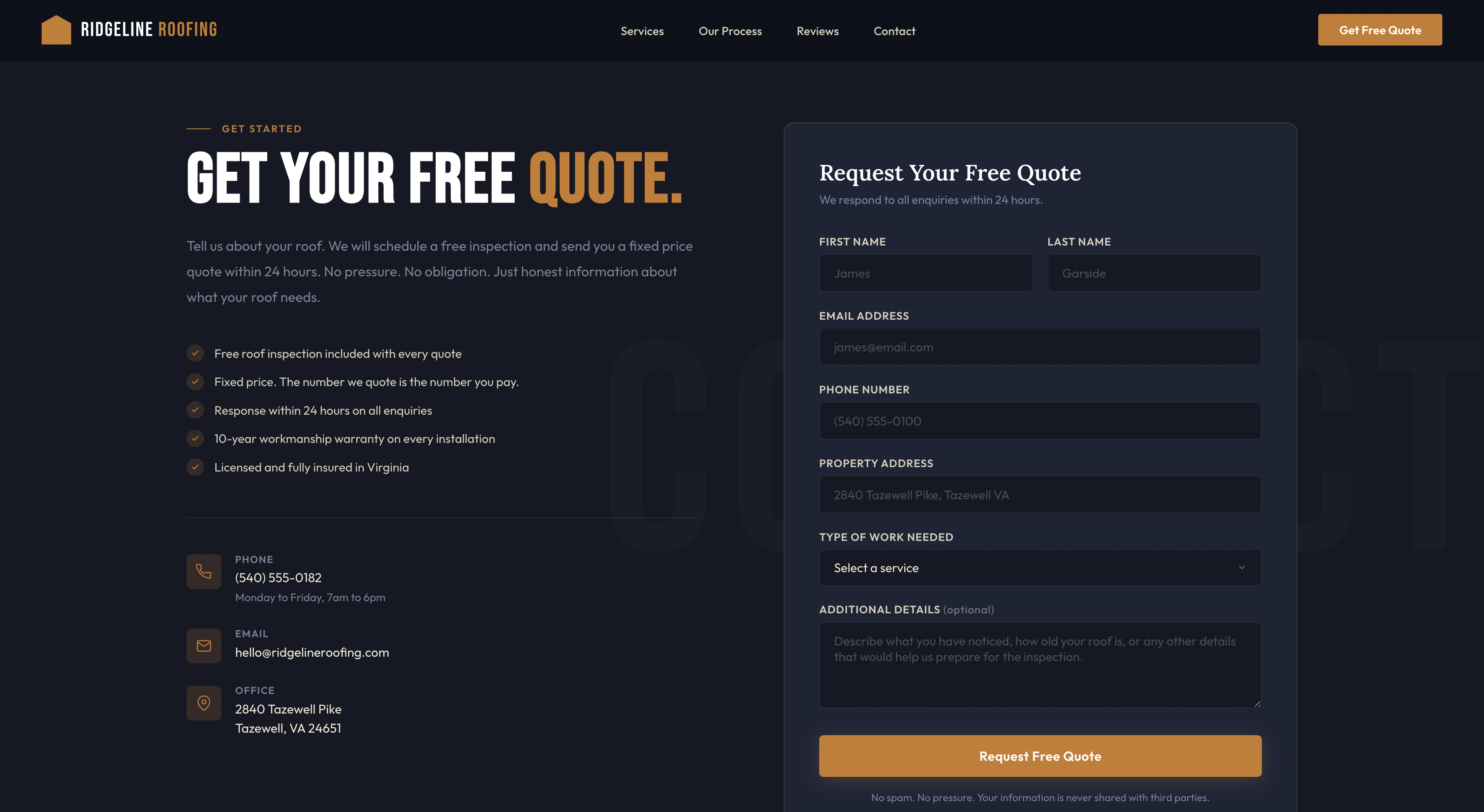
Walk through your own website like a homeowner who just noticed their roof is leaking after last night's rain. They are on their phone. They are a little stressed. They want to find someone who can help quickly.
Where is your contact form? Is it on a separate Contact page buried in the navigation? Does it ask for their name, email, phone number, address, type of work, roof size, year of installation, and a message?
Every additional field on a contact form costs you submissions. Research consistently shows that forms asking for more than five to six pieces of information see significantly lower completion rates than simpler ones. A homeowner on their phone during their lunch break will not fill in an eight-field form. They will close the tab and call the next roofer they find.
The fix is not a beautiful form. It is a simple one. Name, phone number, email, type of work needed, and an optional message. That is enough to start a conversation. You can collect everything else when you call them back.
The other part of this is placement. Your form should not live only on a Contact page. It should appear on your homepage, on your services pages, and ideally at the bottom of every page a visitor might land on from a Google search. A homeowner who lands on your storm damage page from a Google search should not have to navigate anywhere to request a quote. It should be right there.
Problem 2: You Have No Way to Follow Up Systematically
A homeowner fills in your contact form at 2 pm on a Tuesday. Your website sends you an email notification. You are on a job. You see the email at 5 pm. You plan to call tomorrow morning.
By then, they had already spoken to two other roofers who responded faster.
The data on this is stark. Leads contacted within five minutes of submitting a form is nine times more likely to convert than leads contacted after thirty minutes. By the time 24 hours have passed the conversion probability has dropped to almost nothing for a homeowner with an urgent problem.
This is not about being available every minute of every day. It is about having a system that captures the lead properly and ensures nothing slips through.
When a quote request comes in, you need to know about it immediately. You need the full details in one place. You need to be able to mark it as contacted when you reach out. You need a reminder set for the follow-up date, so that if they do not answer on Tuesday you do not forget to try again on Thursday.
Most roofing websites do not give you any of that. The email arrives. You either respond or you do not. There is no pipeline. There is no tracking. There is no visibility into which leads you followed up on and which ones went cold.
Problem 3: You Cannot Tell Which Marketing Is Sending You Leads
You are running Google Ads. You are posting on Facebook. You did a letterbox drop last month. You get referrals from past customers. You have a presence on a few local directories.
Which one of those is sending you quote requests? Which one is sending you the jobs that actually become paying customers, rather than people who enquire and go quiet?
If your current setup is a contact form that sends you an email, you have no way to answer that question. The submission arrives with a name and a phone number. There is nothing in it that tells you the person came from your Facebook ad or from the Google search they did after a storm.
This matters enormously for where you spend your money and your time. A roofer spending $800 a month on Google Ads, who discovers that 80 percent of their actual paying customers came from Facebook organic posts have made a significant discovery. Without source tracking on your enquiry form, that discovery is impossible to make.
Problem 4: Your Mobile Experience Is Losing You Leads Before They Even See Your Form
The majority of roofing searches happen on smartphones. A homeowner notices something wrong with their roof. They pick up their phone and search. They land on your site.
If your site loads slowly on mobile, you have already lost a significant portion of those visitors before they see a single word about your company. If your form is hard to fill in on a small screen, you lose another portion. If the submit button is below the fold and not obvious on mobile, you lose more.
The visitors who leave because of these friction points do not disappear. They go to the next result and call that roofer instead.
Testing your own site on your phone from the perspective of a first-time visitor takes ten minutes and will tell you more about your conversion problem than any analytics tool.
Problem 5: There Is No Evidence You Are Real and Trustworthy
Homeowners are making a significant decision when they contact a roofing company. They are going to let strangers on their roof. They are going to pay thousands of dollars for work they cannot supervise. They are trusting that the finished result is what they paid for.
Before they submit a form, they are looking for evidence that you are legitimate, that past customers had good experiences, and that you will not disappear after taking the deposit.
If your website has no visible reviews, no before-and-after photos of real jobs, no information about how long you have been operating, and no details about the people who will actually do the work, visitors will hesitate. And hesitation on a contact form means abandonment.
Trust signals do not have to be elaborate. Five genuine Google reviews displayed prominently. Three before and after photos with the location and type of work listed. A statement about how many years you have been operating and whether you use your own crew or subcontractors. These are small things that significantly reduce the hesitation that stands between a visitor and a submitted form.
What a Lead Generation System for a Roofing Website Actually Looks Like
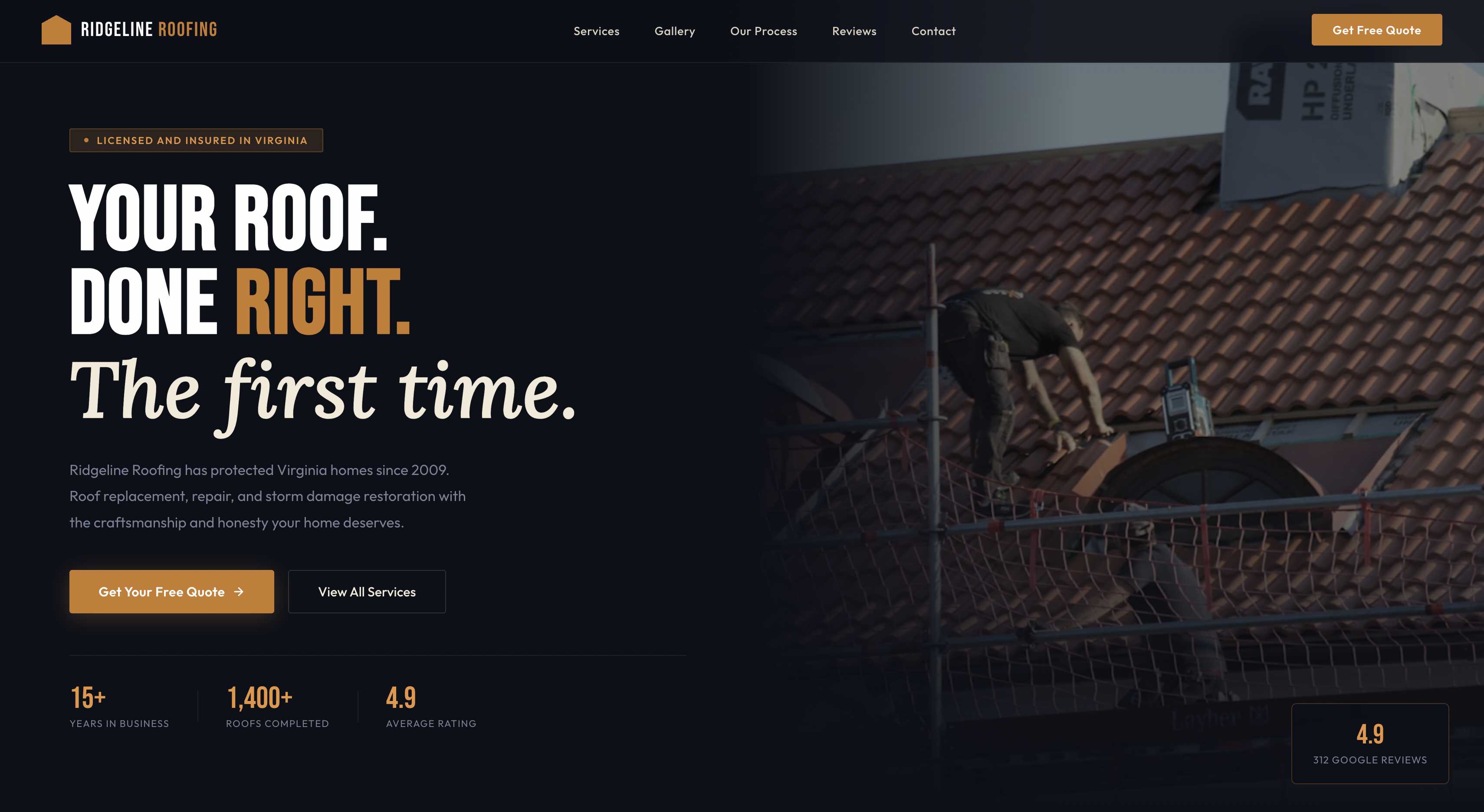
Fixing the problems above does not require a new website. It requires adding the right infrastructure to what you already have.
A properly set up roofing lead system does the following:
Captures the enquiry immediately. A simple form on every relevant page with no more than six fields. Name, phone, email, property address, type of work, and an optional photo upload for homeowners who want to show you the damage. The form is prominent on mobile. It is above the fold on service pages. It has a clear and specific call to action that says something like "Request Your Free Inspection" rather than the generic "Contact Us."
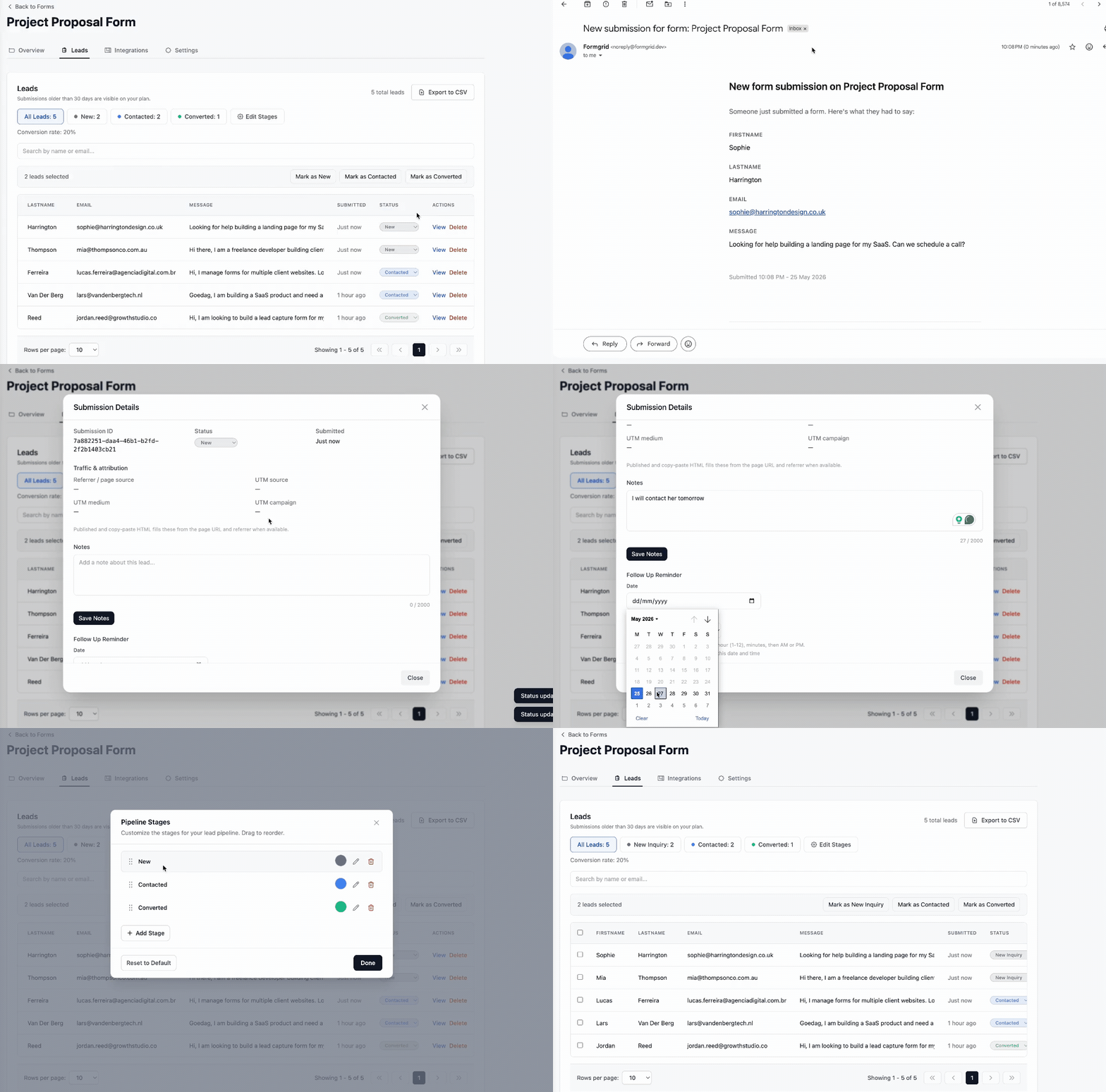
Routes the lead into a trackable pipeline. Every submission lands in a dashboard as a named lead with a status. New when they arrive. Contacted when you reach out. Converted when they become a job. You can see at any moment how many active leads you have, which ones you have not followed up on, and what your overall conversion rate looks like. That visibility alone changes how you run the business.
Sends you an immediate notification. An email arrives the moment someone submits a form. Not a daily digest. Not a weekly summary. An immediate notification with the lead's full details so you can respond quickly while they are still thinking about their roof and have not yet called the next company on the list.
Syncs automatically to Google Sheets. If you have an office manager or admin team who coordinate jobs, they should not need to log into a separate tool to see incoming enquiries. Every new submission can appear as a new row in a shared Google Sheet automatically. The whole team sees new leads without anyone manually transferring data.
Tells you where each lead came from. Using tracked links with UTM parameters, each version of your enquiry form link can carry a label showing whether the visitor came from your Google Ad, your Facebook post, your local directory listing, or a referral. That information attaches to the lead automatically when they submit. After 30 days, you can see exactly which channel is generating real enquiries and which ones are generating nothing.
Reminds you to follow up. If a lead does not answer when you call on Tuesday, you set a follow-up date for Thursday. On Thursday, you receive an email with the lead's details and any notes you added. You pick up the phone with the full context in front of you. The lead never gets forgotten because you were busy on a job.
A Real Example of What This Changes
A roofing company serving a regional area was getting around 600 website visitors per month from local Google searches. Their contact form was on a dedicated Contact page. It had nine fields. They were receiving around three to four enquiries per month.
They simplified the form to five fields and placed it on their homepage and on each of their service pages. They added a photo upload field so homeowners could send pictures of damage. They connected the form to a simple lead pipeline so every submission appeared as a tracked lead rather than just an email. They set up Google Sheets sync so their office manager could see new leads without logging into anything new.
Within the first month, enquiries went from three or four to fourteen. The traffic had not changed. The ad budget had not increased. The only thing that changed was what happened to the traffic after it arrived.
Fourteen enquiries per month from 600 visitors is still a modest conversion rate. But it is the difference between a quiet phone and a pipeline of active jobs to work through.
The Tool Behind This Setup
The lead system described above is built using Formgrid. Formgrid started as a form backend for static websites and later added a drag-and-drop form builder. Every submission becomes a tracked lead with a pipeline, notes, follow-up reminders, and automatic Google Sheets sync.
The free plan is available with no credit card required. Premium starts at $8 per month and includes file uploads, CSV export, and up to 500 Google Sheets rows per month.
For roofing companies that want the entire system set up for them including the landing page, form, Google Sheets integration, and UTM tracking there is a done-for-you option starting at $500.
See how Formgrid helps roofing companies get more quote requests →
The Summary
If your roofing website is getting traffic but not generating quotes requests the problem is almost certainly one of these five things:
Your form is buried, complicated, or hard to use on mobile.
You have no system for following up quickly and consistently.
You cannot see which marketing is actually sending you leads.
Your mobile experience is creating friction before visitors even reach your form.
Your site lacks the trust signals that give homeowners the confidence to submit their details.
None of these requires rebuilding your website from scratch. Each one is a specific fix. Fix them, and the traffic you already have will start turning into the quote requests your business runs on.
Running a roofing business and want help setting up a lead system that works? Reach out at allen@formgrid.dev, and we can talk through what makes sense for your setup.
Comments
Leave a comment