
Formspree is one of the most popular form backends for static sites, and it deserves that reputation. It is reliable, well-documented, and easy to set up. If you need a form backend that just works, Formspree works.
But if you have ever received a form submission, replied to it a day later, and watched the lead go cold. Formspree cannot help you with that. It was never designed to.
That is the gap Formgrid was built to fill.
This comparison covers every meaningful difference between the two tools in 2026 so you can decide which one is right for your situation.
The One Line Summary
Formspree collects submissions. Formgrid manages leads.
That distinction sounds small. In practice, it changes everything about how you run your business.
What Formspree Does
Formspree is a form backend service. You point your HTML form at a Formspree endpoint, and every submission is received. spam filtered, stored, and forwarded to your inbox.
It does that job cleanly and reliably. No complaints there.
<!-- Formspree endpoint -->
<form action="https://formspree.io/f/your-form-id"
      method="POST">
  <input type="text" name="name" required />
  <input type="email" name="email" required />
  <textarea name="message"></textarea>
  <button type="submit">Send</button>
</form>
What happens after the submission hits your inbox is entirely up to you.
Did you reply? Did you follow up? Did they become a customer? Formspree has no idea. Neither do you unless you are tracking it somewhere else.
What Formgrid Does
Formgrid does everything Formspree does at the point of submission. Same one line code change:
<!-- Formgrid endpoint -->
<form action="https://api.formgrid.dev/f/form_id
your-form-id/submissions"
      method="POST">
  <input type="text" name="name" required />
  <input type="email" name="email" required />
  <textarea name="message"></textarea>
  <input type="text" name="_honey"
         style="display:none" />
  <button type="submit">Send</button>
</form>
But that is where the similarity ends.
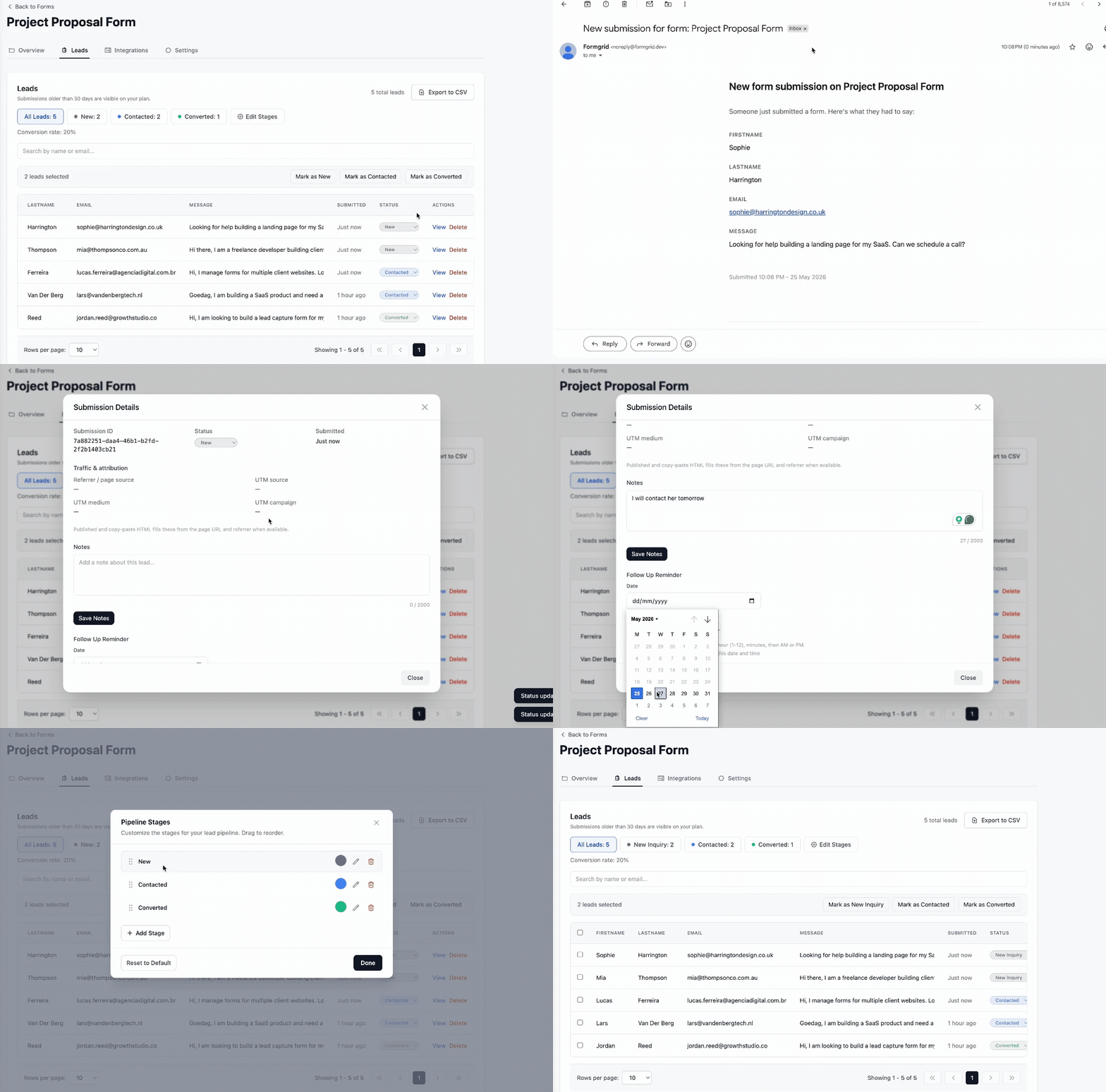
Every submission that arrives does not just sit in a flat list. It becomes a tracked lead with a status, a notes field, and a follow-up reminder you can set in one click. Google Sheets sync runs automatically in the background. No Zapier needed.
The submission landing in your dashboard is not the end of the workflow. It is the beginning.
The Full Feature Comparison
| Feature | Formspree | Formgrid |
|---|---|---|
| HTML form endpoint | Yes | Yes |
| Email notifications | Yes | Yes |
| Submissions dashboard | Yes | Yes |
| CSV export | Yes | Yes |
| Spam protection | Yes | Yes |
| File uploads | Paid | Yes |
| Form builder | No | Yes |
| Shareable form link | No | Yes |
| Lead pipeline | No | Yes |
| Notes on every lead | No | Yes |
| Follow up reminders | No | Yes |
| Conversion rate tracking | No | Yes |
| Google Sheets sync | $90/month | Free |
| UTM source tracking | No | Yes |
| Self-hostable | No | Yes |
| Open source | No | Yes |
| Free submissions | 50/month | 50/month |
| Starting price | $15/month | $12/month |
| GDPR friendly | Partial | Yes |
The technical foundation is similar. What happens after the submission is not even close.
The Four Things That Make Formgrid Different
1. A Lead Pipeline Built Into Every Form
In Formspree, every submission looks the same regardless of where it is in your sales process. There is no way to mark something as replied to, flag a hot lead, or see at a glance which enquiries need your attention today.
In Formgrid, every submission becomes a lead with three stages: New: You have not replied yet Contacted: You have been in touch Converted: They became a customer
At the top of your leads tab, you see your full pipeline summary and your conversion rate updating automatically: New: 12 Contacted: 8 Converted: 3 Conversion rate: 13%
That number alone changes how you think about your contact form. It is not just about collecting messages. It is driving revenue.
2. Notes on Every Lead
After you call a potential customer and they tell you their budget is tight until next quarter and to follow up in July, you need to write that down somewhere, attached to that specific person.
Formspree has no notes field. You end up writing it elsewhere or trying to remember.
In Formgrid, every lead has a notes field. Write whatever you need to remember: Called Thursday. Interested in the monthly package. Budget around $800. Partner needs to approve. Follow up after the 20th.
The next time you open that lead, your note is right there. You know exactly where the conversation left off before you pick up the phone. You sound prepared. You close more deals.
3. Follow-Up Reminders
Most leads do not convert on the first contact. They need a follow-up. Sometimes two or three.
Formspree has no way to set a reminder on a lead. Whether you follow up is entirely up to you and your memory. Most of the time, you forget. The lead goes cold. You lose a customer you could have won with one timely email.
In Formgrid, you set a follow-up reminder directly on the lead. Pick a date. Click Set Reminder.
On that date, Formgrid emails you with the lead details and your notes so you have everything you need before you follow up.
You set it once. Formgrid handles the rest.
4. Google Sheets Sync Without Zapier
Formspree charges $90 per month for Google Sheets integration. That is on top of your base plan cost.
Formgrid includes Google Sheets sync on every plan, including the free plan. Connect your Google Sheet once in your form settings, and every submission appears as a new row automatically. Your whole team sees new leads in real time without logging into anything.
No Zapier. No extra cost. No setup beyond connecting your Google account once.
Pricing Comparison
| Plan | Formspree | Formgrid |
|---|---|---|
| Free | 50 submissions/month | 50 submissions/month |
| Basic paid | $15/month for 200 submissions | $12/month for 1,000 submissions |
| Google Sheets | $90/month | Free on all plans |
| Custom email templates | $60/month | $29/month |
| Self-hosting | Not available | Free on Docker |
Formgrid gives you 5x more submissions at the basic paid tier for $3 less per month. And Google Sheets sync that Formspree charges $90 per month for is free.
A Real Example: What the Difference Looks Like in Practice
One of Formgrid's customers runs endurance horse ride events. She was using a basic form backend and getting registration submissions forwarded to her inbox. A 75-year-old ride manager was receiving raw data dumps with field names and values she could not read.
After switching to Formgrid, she connected her form in minutes, set up a custom email template so every registration arrived as a clean, formatted email her ride manager could actually read, and connected Google Sheets so the whole team could see registrations in real time without accessing her email.
Every registration now appears as a tracked lead in her pipeline. She knows exactly how many riders registered, how many she has confirmed, and how many are still pending. All from one dashboard.
She is on the Business plan at $29 per month. Formspree would charge $90 per month for Google Sheets alone without any of the lead tracking features.
When Formspree Is Still the Right Choice
To be completely honest, Formspree is a perfectly good choice in one specific situation.
If you are a developer building a simple contact form for a portfolio site or a static site where submissions are just notifications and nothing more, Formspree works fine. You are not trying to convert those submissions into customers. You are just receiving messages.
The pipeline, the notes, and the follow-up reminders add no value for that use case.
But the moment those submissions represent real revenue opportunities, the calculation changes completely.
When Formgrid Is the Right Choice
Use Formgrid if any of these apply to you:
You are a small business taking enquiries from potential customers and need to track what happens after they submit.
You are paying for Formspree and want more submissions at a lower price.
You need Google Sheets sync without paying $90 per month on top of your base plan.
You want to know your actual conversion rate from form submissions to paying customers.
You care about open source and self-hosting with full data ownership.
You need a form builder with a shareable link as well as an HTML form endpoint in the same tool.
How to Switch From Formspree to Formgrid
If you are already using Formspree, the migration takes about five minutes, and your form does not change at all.
Step 1: Sign up for free at formgrid.dev. No credit card required.
Step 2: Create a new form and copy your Formgrid endpoint URL from the Overview tab.
Step 3: Replace your Formspree endpoint URL with your Formgrid endpoint URL in your HTML form. One line change. Done.
<!-- Before: Formspree -->
<form action="https://formspree.io/f/your-id"
      method="POST">

<!-- After: Formgrid -->
<form action="https://api.formgrid.dev/forms/
your-form-id/submissions"
      method="POST">
Every submission now lands in a lead pipeline with a status, a notes field, and a follow-up reminder you can set in one click. Google Sheets sync connects in under a minute.
Your form works exactly as before. What happens after the submission arrives is completely different.
Final Thoughts
Formspree is not a bad product. For a developer who needs a reliable form backend for a static site, it is a solid choice.
But for a small business where every form submission is a potential customer, a tool that stops at the inbox is leaving money on the table.
Every enquiry that goes unanswered is because you lost track of it. Every warm lead that went cold because you forgot to follow up. Every customer you could have won but did not because you had no system.
Those are not Formspree's fault. But they are a problem Formspree is not designed to solve. Formgrid is.
👉 Try Formgrid for free No credit card required.
Free plan available. Switching from Formspree takes five minutes, and your form does not change at all.
If you have questions about switching or setting up lead tracking for your specific use case, reply in the comments or email allen@formgrid.dev directly.
Comments
Leave a comment