
Typeform's Free Plan Caps You at 10 Responses?
Get the same conversational form experience, a landing page around it, an HTML backend, and lead tracking, starting at $12 a month against Typeform's $25.

If you have been using Typeform and recently looked at your bill, you are not alone. Typeform's free plan limits you to 10 responses per month, and their paid plans start at $25 per month just to get basic features. For a lot of developers, indie hackers, and small businesses, that is hard to justify.
In this article, I will walk through the best Typeform alternatives in 2026, covering price, features, self-hosting options, and which one is right for your use case.
Short Version
If you want the same conversational form experience as Typeform, plus a landing page around it, an HTML backend, and a way to track what happens to a submission after it arrives, use Formgrid. It starts at $12 a month against Typeform's $25.
If branding does not matter and you just need something free for internal use, Google Forms is genuinely the simplest option, and it costs nothing.
If you specifically need Typeform's design polish for a survey or NPS use case and budget is not the concern, it is still a fine choice.
Why Developers and Businesses Look for Typeform Alternatives
Here are the most common reasons people switch:
Price. Typeform's free plan is almost unusable at 10 responses per month. Paid plans are expensive for what you get.
No HTML form backend. Typeform is a hosted form builder only. You cannot point your existing HTML form at a Typeform endpoint.
No self-hosting. If you care about data ownership or GDPR compliance, Typeform gives you no option to run it yourself.
No lead management. Typeform collects responses and shows you a dashboard. It does not tell you who followed up, who converted, or who went cold.
No captcha or bot protection. Typeform has no built-in bot protection. Spam submissions reach your dashboard without any filtering on lower plans.
Overkill for simple use cases. Typeform's conversational UI is beautiful but completely unnecessary if you just need a contact form or a quote request form.
No open source option. You are locked in with no transparency or customisation.
If any of those hit home, keep reading.
The Best Typeform Alternatives in 2026
1. Formgrid: Multi-Step Forms, Lead Management, and Self-Hosting in One Tool
Formgrid is the only form tool on this list that combines multi-step conversational forms, professional landing page templates, an HTML form backend, a full lead pipeline with follow-up reminders and conversion tracking, free captcha bot protection, and Google Sheets sync, at $12 per month. Typeform charges $25 per month for conversational forms alone, with none of those additional features.
Best for: event organizers, small businesses, and developers who want a form that looks professional, tracks leads automatically, blocks bots for free, and works without a backend.
What makes it different
Most form tools pick a lane. Either a drag-and-drop form builder or a form backend for developers. Formgrid does both, and it adds something neither Typeform nor most alternatives offer: a multi-step conversational form builder, landing page templates that wrap your form in a complete branded page, and a full lead pipeline that tracks every submission from New to Contacted to Converted automatically.
How Jezy uses it
Jezy runs a volleyball club and started on a free plan that capped her at a handful of responses a month, the same wall Typeform's 10-response free tier puts people up against. She hit that limit during signup season and upgraded rather than lose track of players trying to register. Now every signup lands in her dashboard as a lead she can move through the pipeline, so she can tell at a glance who has actually paid their dues versus who just filled out the form and never followed through.
Option A: use your existing HTML form
If you already have an HTML form on your website, just point it at your Formgrid endpoint URL. No other changes needed:
<form
  action="https://formgrid.dev/api/f/your-form-id"
  method="POST"
>
  <input type="text" name="name" placeholder="Your Name" required />
  <input type="email" name="email" placeholder="Your Email" required />
  <textarea name="message" placeholder="Your Message"></textarea>
  <input type="text" name="_honey" style="display:none" />
  <button type="submit">Send Message</button>
</form>
Formgrid handles receiving submissions, sending email notifications, and storing the data. Your form stays exactly as it is.
Option B: start from a landing page or multi-step template
This is the most powerful thing Formgrid does that Typeform cannot. Instead of getting a bare conversational form on a white page, you choose a professionally designed landing page template and your form is embedded inside it. Or you choose the multi-step format for a true one question at a time experience. Either way, the result is a complete branded page that you are proud to share anywhere, and you do not need an account to start.
Head to the Formgrid templates page and open the Quote Request template. It is a multi-step form built for exactly the kind of lead capture most small businesses and freelancers need: contact details on the first step, project or service details on the second, and budget or timeline on the last.
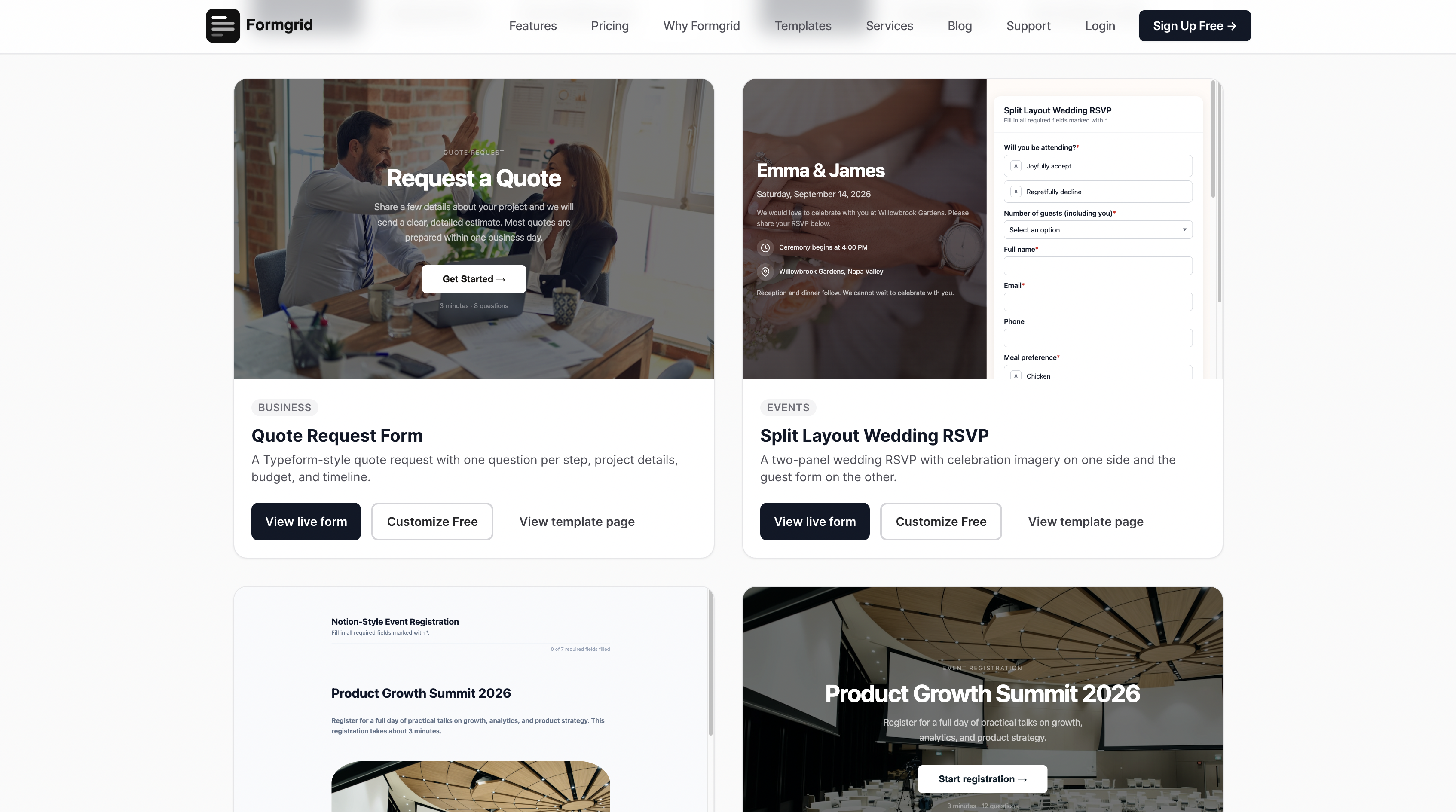

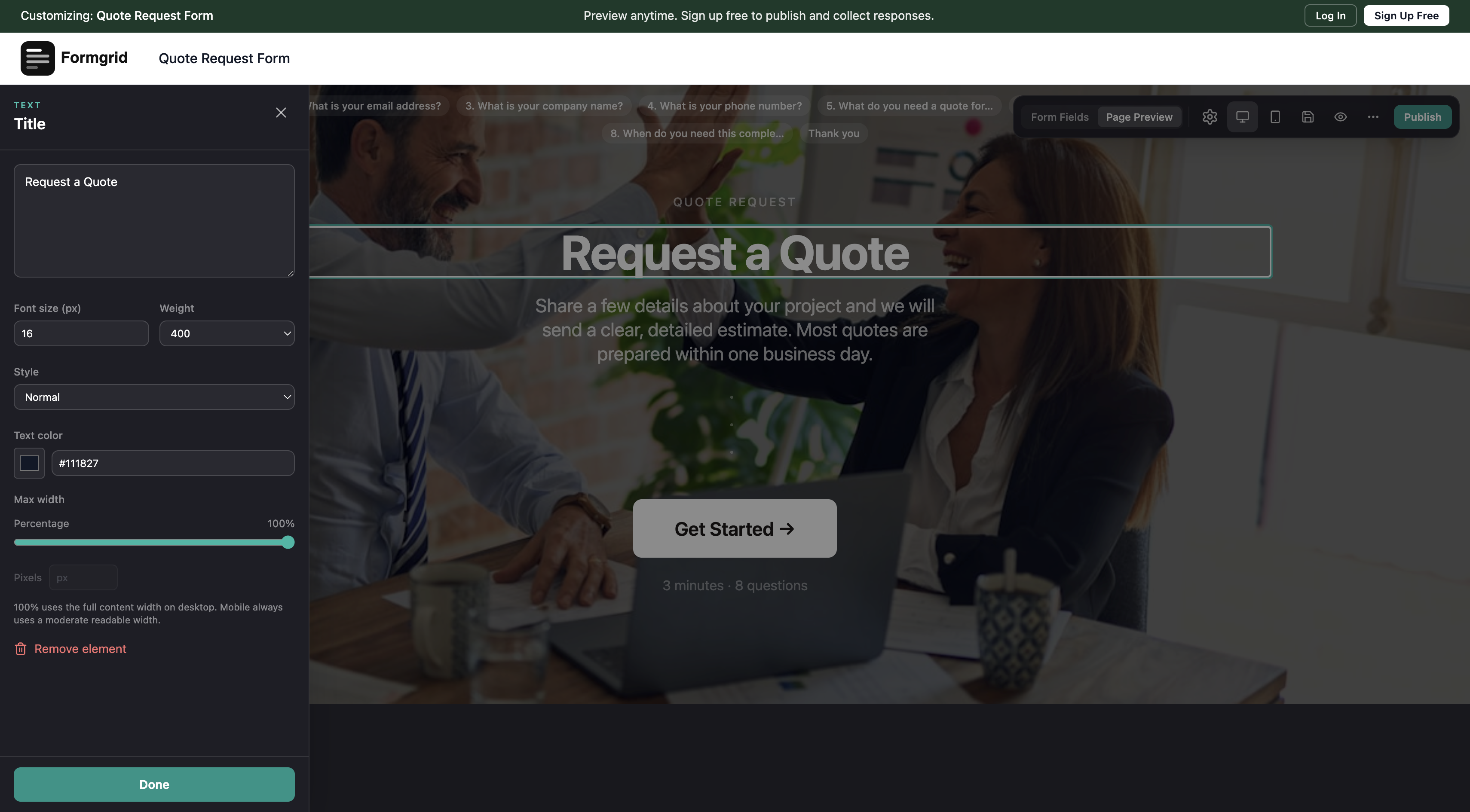
You can try the anonymous builder right there in the browser. Change the headline, edit the steps, swap the color, and preview exactly what your visitor will see before you ever create an account. Only when you are happy with it do you click Save, at which point you are prompted to sign up. You can view and customize this template here.
The same one question at a time conversational format is included on all plans, including free, at no extra cost. Any multi-step form, including the Quote Request template, can be switched into a conversational layout with a progress bar and animated transitions between fields, the same style Typeform is known for. It is a toggle in the builder, not a separate product, so you keep the same submissions, notifications, lead tracking, and Google Sheets sync either way.

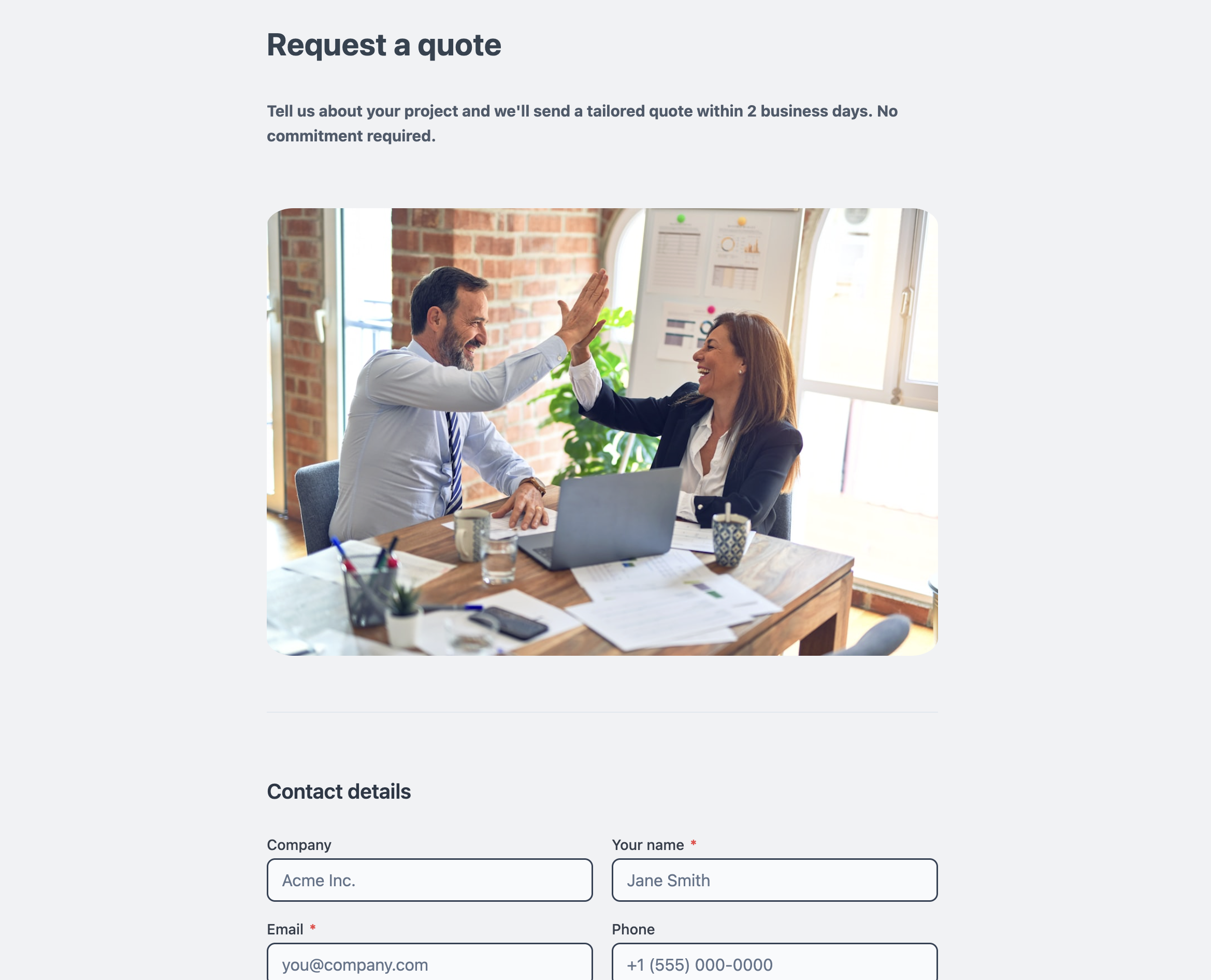
Try the multi-step builder free. No account needed to start customizing.
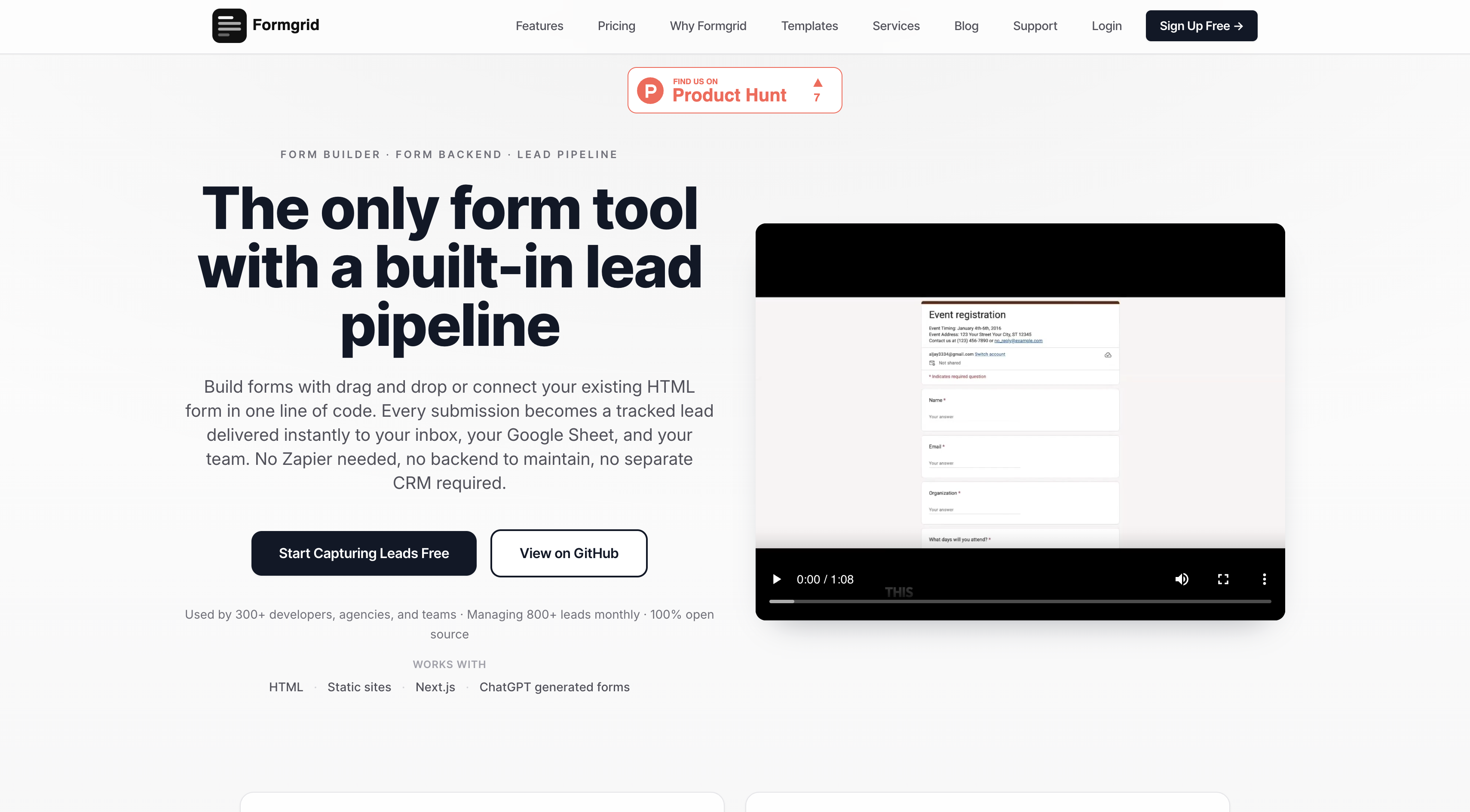
Step 1: sign up and create a form
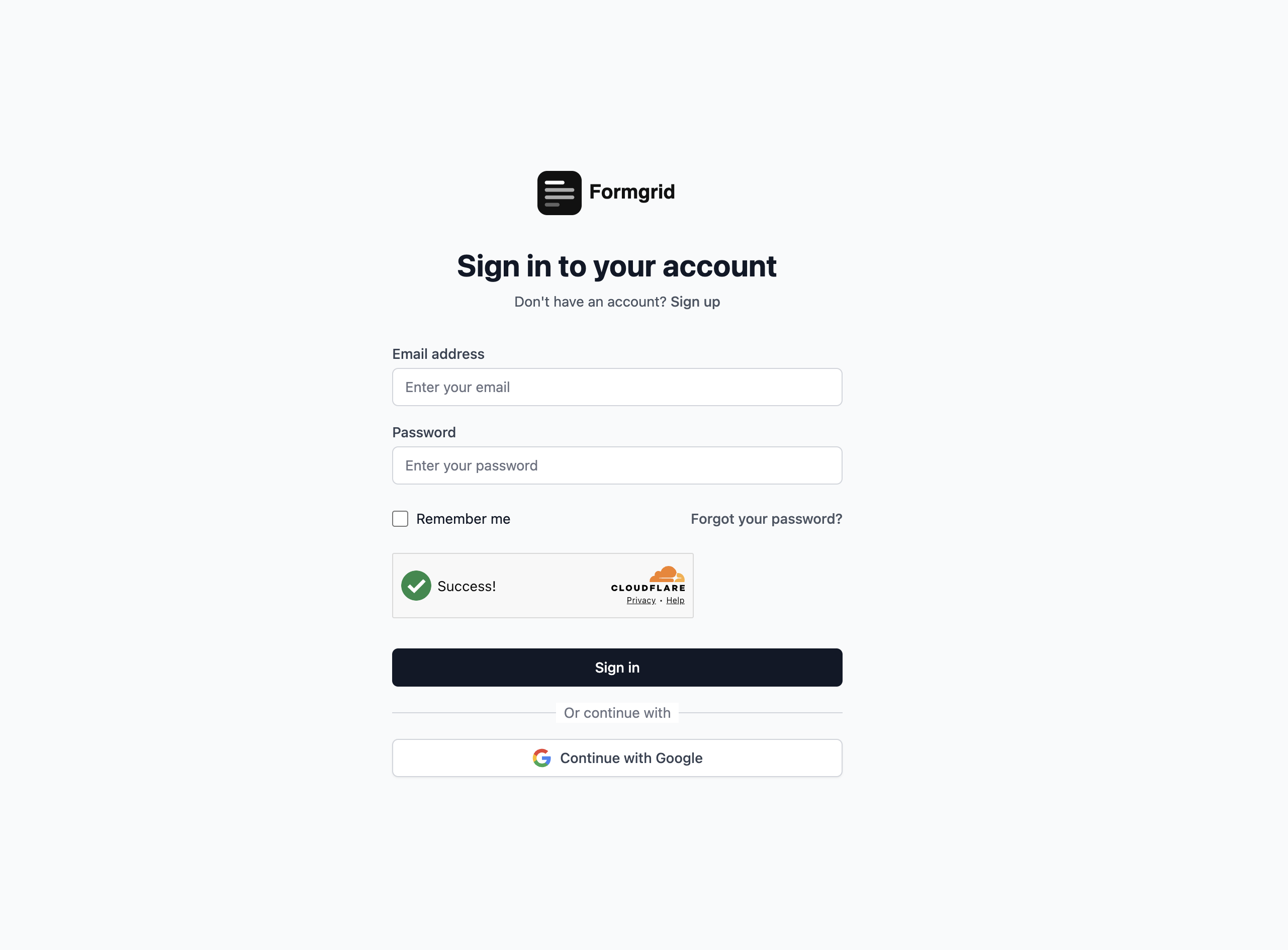
Head to formgrid.dev and sign up using Google or email. No credit card required.
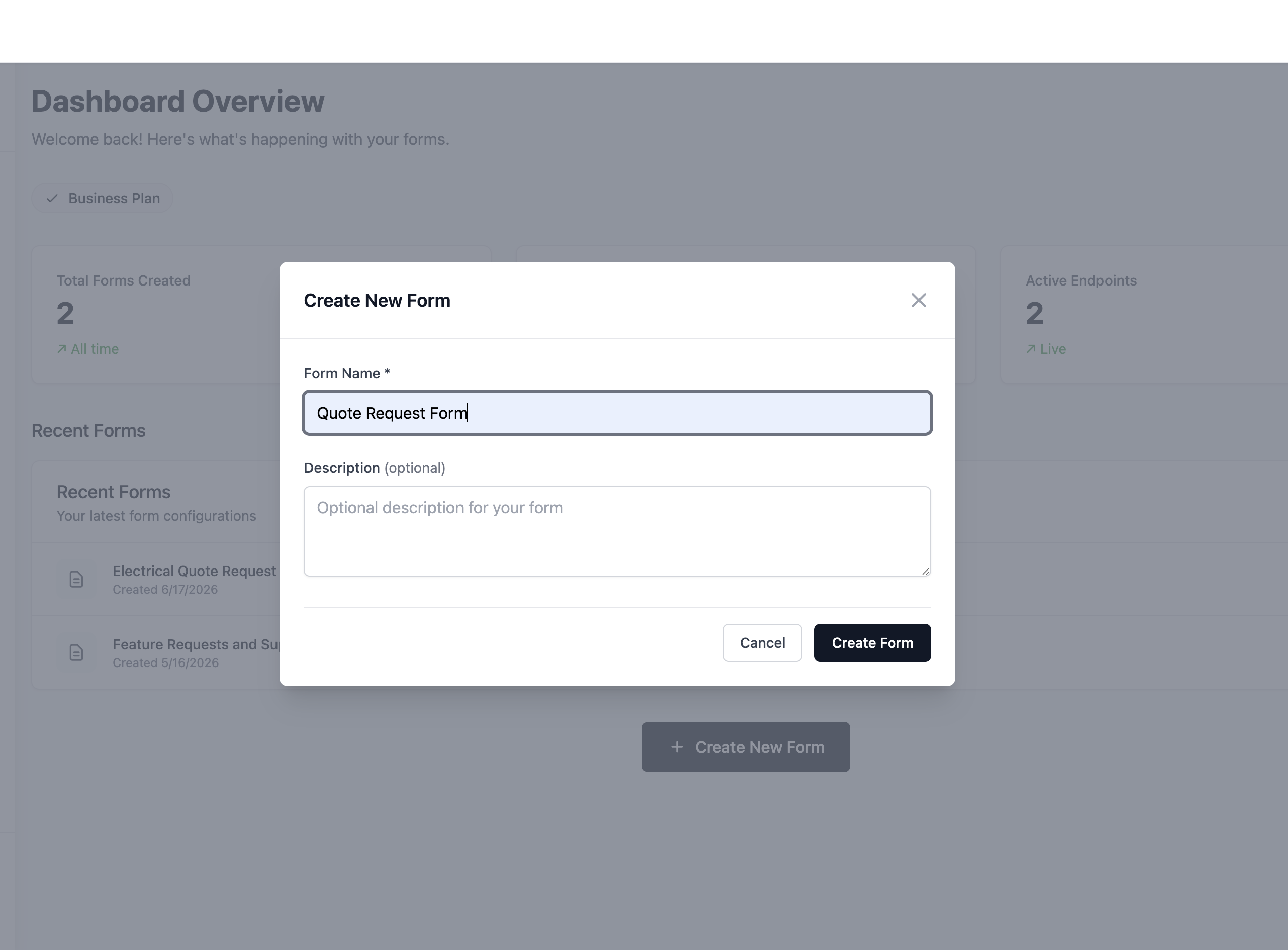
Once logged in, you will land on your dashboard. Click New Form to get started, or open a template you already customized in the anonymous builder.
Step 2: choose your path
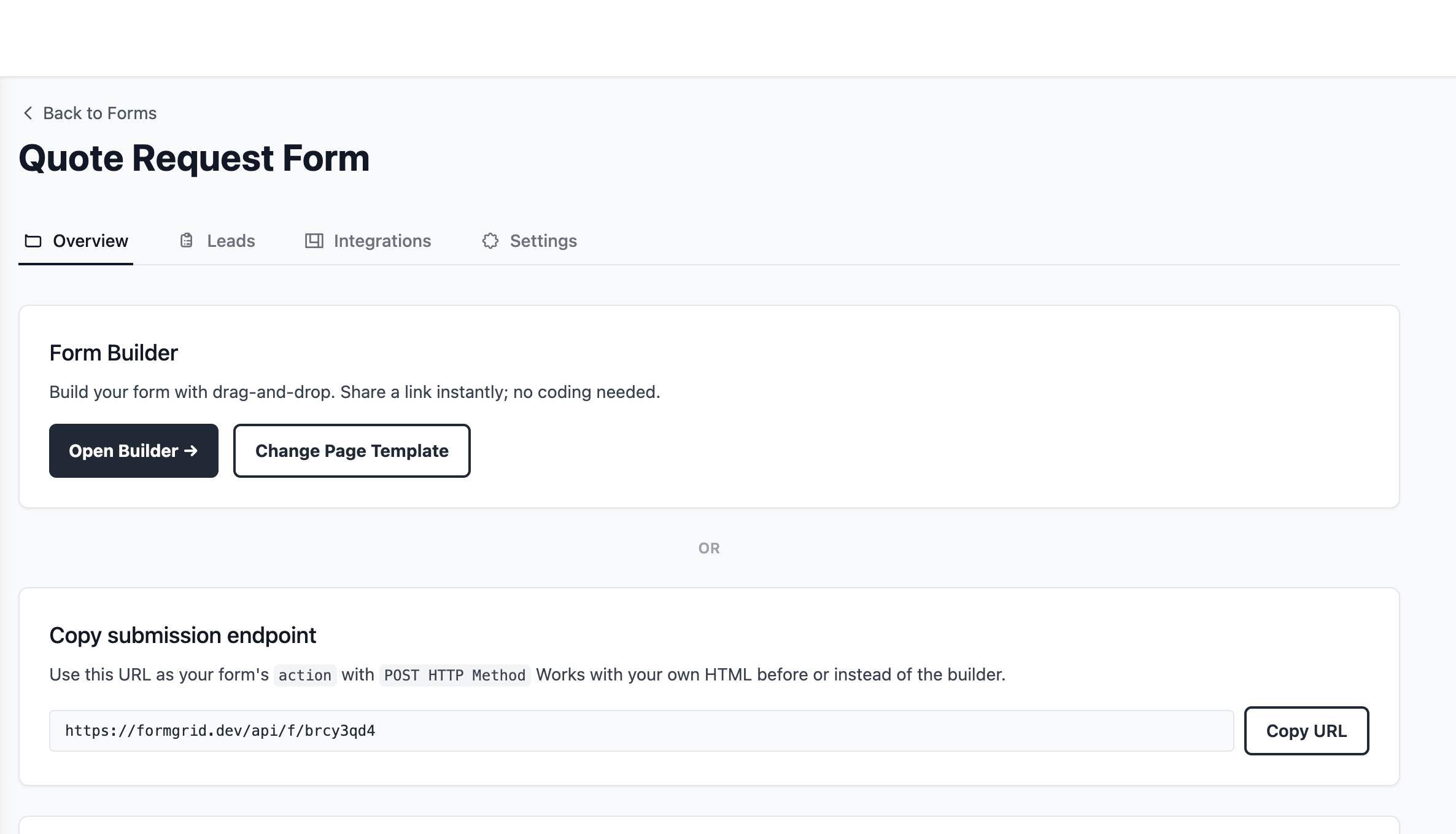
After creating your form, you will be taken to the form overview page, where you can either build with the form builder, opening the drag-and-drop editor from a blank document or a template, or use the endpoint URL, which gives you the URL to point your existing HTML form at.
Step 3: build your form
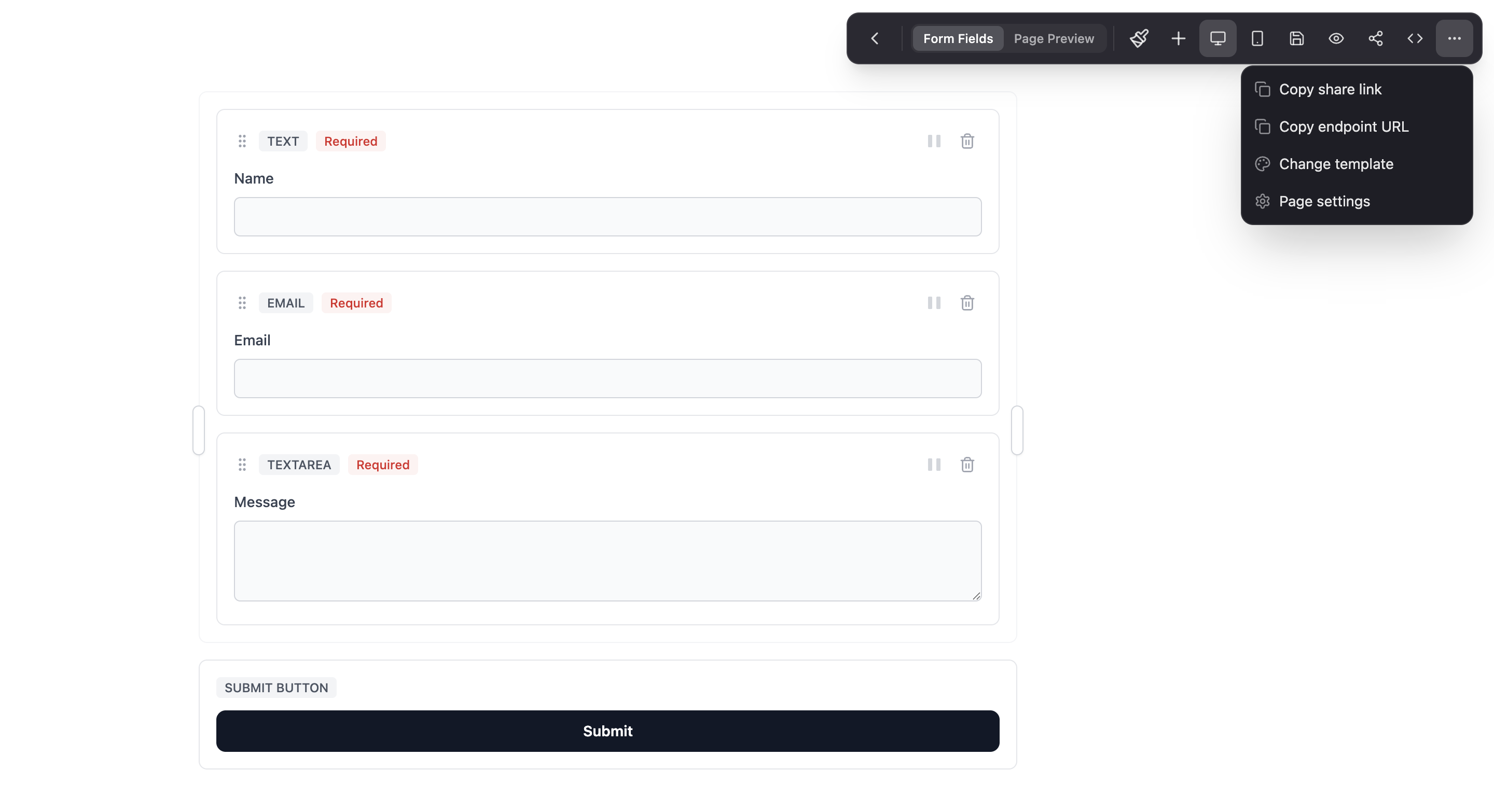
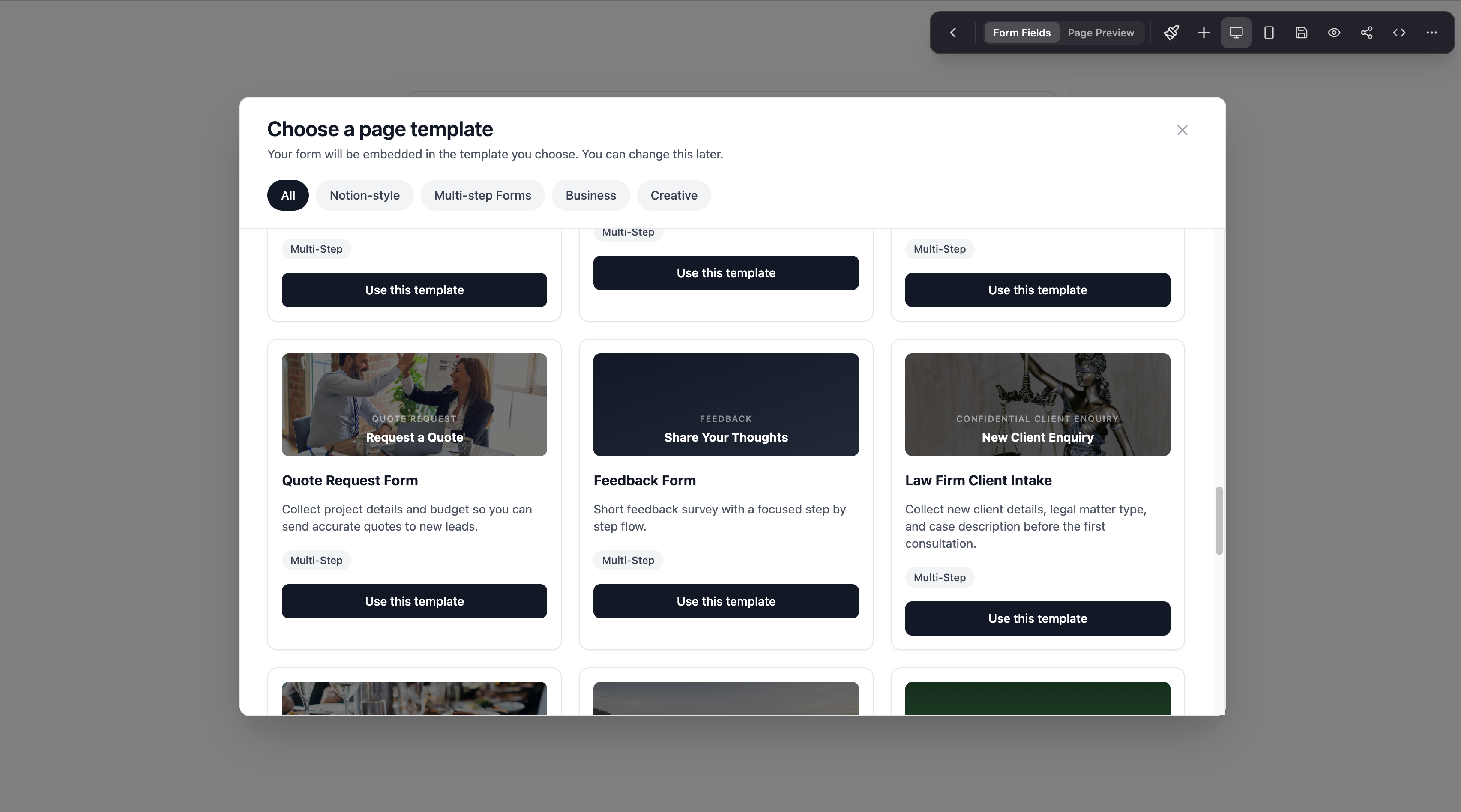
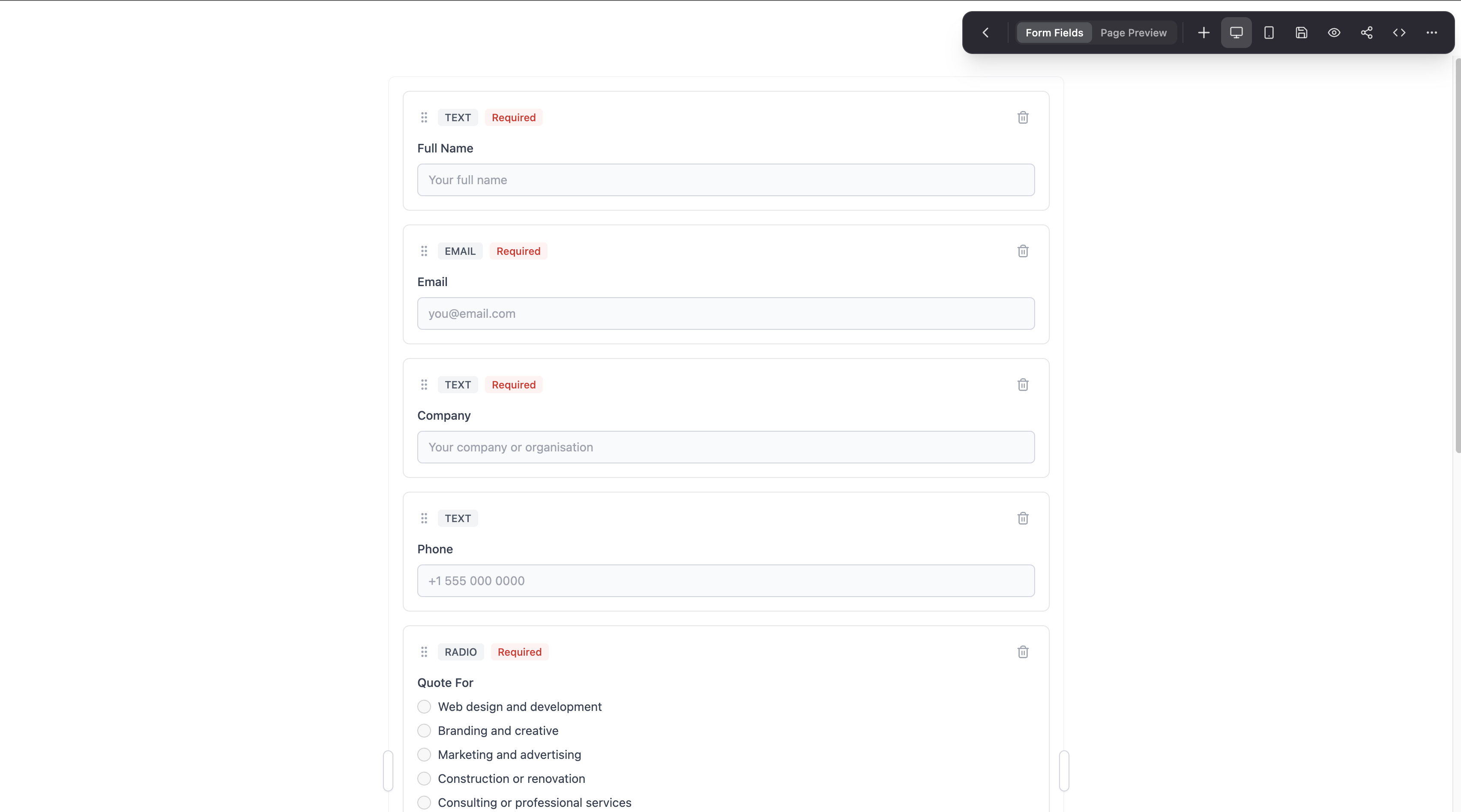
Drag fields from the left panel onto the canvas: text fields, email fields, dropdowns, checkboxes, file uploads, and more. If you started from the Quote Request template, each step already has fields grouped logically, and you can add or remove a page break at any point.
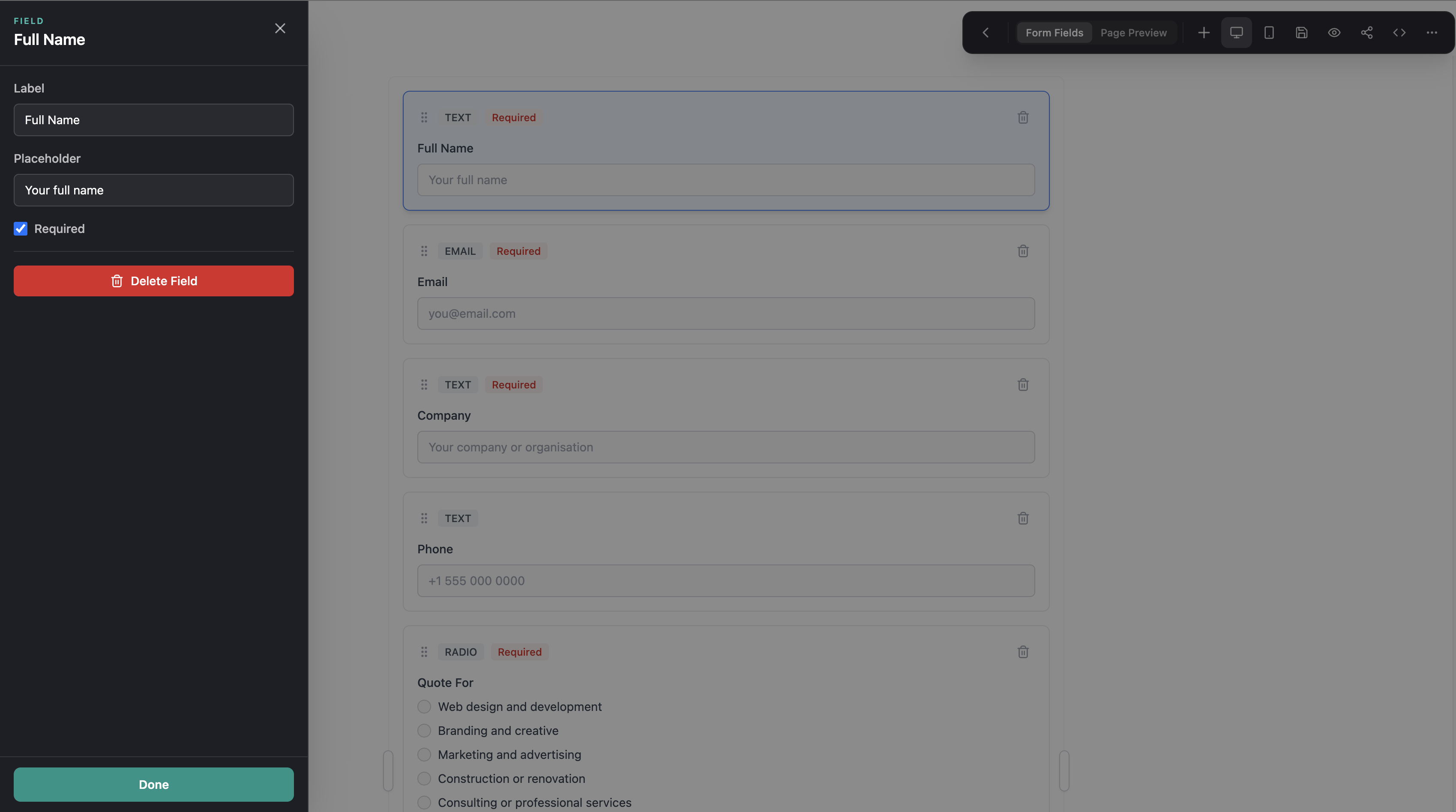
Each field is fully customizable. Click any field to edit its label, placeholder, required status, and validation rules.
Step 4: customize your brand
Formgrid includes a color picker so you can match the form to your brand or your client's brand. Change the primary color, background, and button style directly in the builder.
If you are on the Premium plan, you can also connect a custom domain, so your shareable form link reads as forms.yourbusiness.com instead of formgrid.dev. Every form page also ships with proper OG and SEO meta tags out of the box, so links preview correctly when shared on LinkedIn, Slack, or WhatsApp.
Every form you share looks like it belongs to your brand, not like a generic third-party tool.


Step 5: preview and share
Once you are happy with the form, click Preview to see exactly how it looks to your users. When it is ready, click Share to get your shareable form link.
You can send that link via WhatsApp, email, SMS, or embed it on any website. No code, no hosting, just a link.

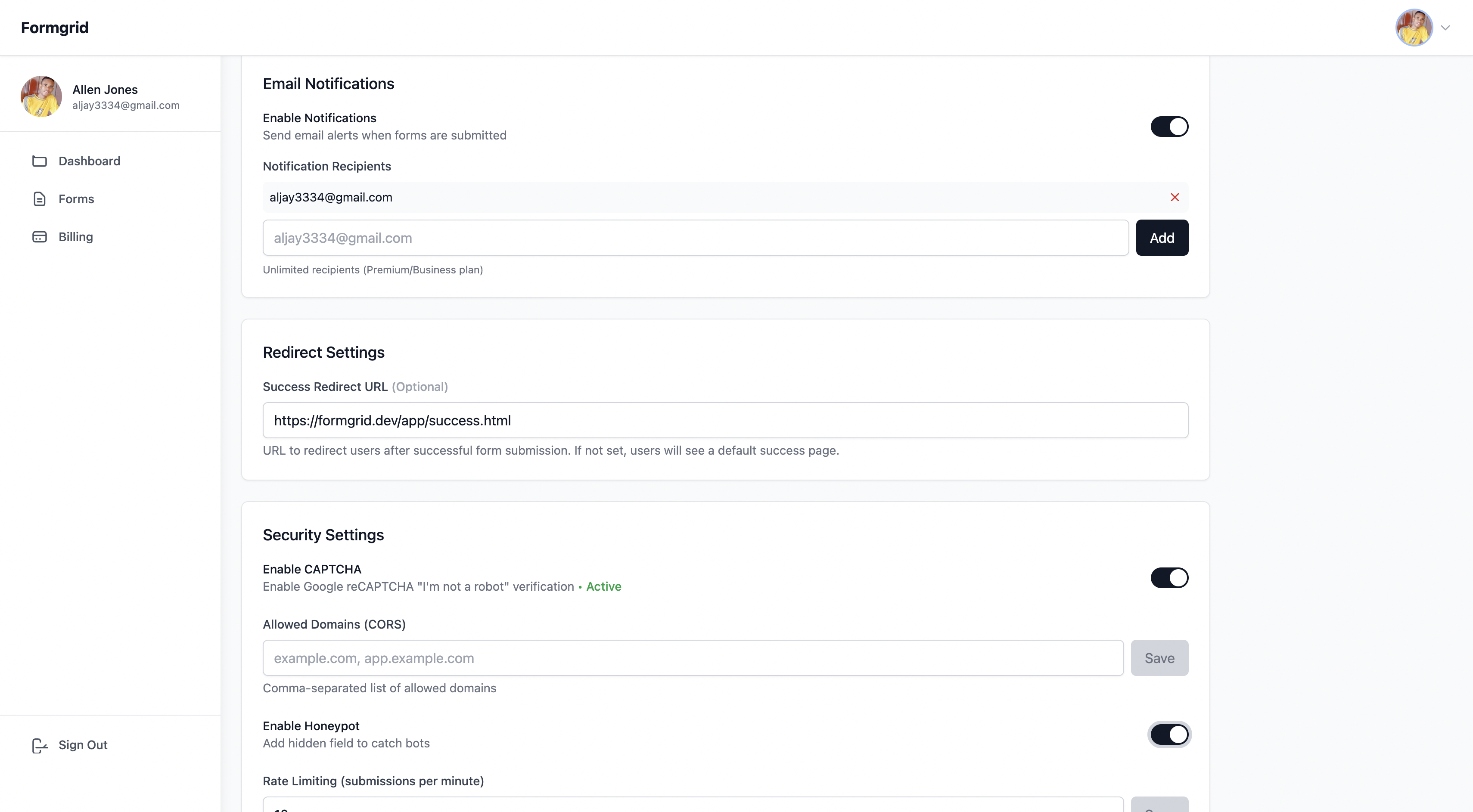
Step 6: configure settings
Go to the Settings tab on your form to:
- Add notification email addresses. Notifications go to the address you signed up with by default, and you can add more if you want teammates or clients to be notified too
- Enable captcha and bot protection, Cloudflare Turnstile for form builder forms and hCaptcha for HTML endpoint forms, at no extra cost on all plans including free
- Set a custom redirect URL after submission
- Configure auto-responder emails on Premium and Business plans
Typeform has no built-in bot protection on lower plans, so this alone covers a gap Typeform leaves open.
Step 7: get notified the moment someone submits, and see it as a lead
Every submission triggers an instant email notification to the addresses you added in Settings. You do not need to log in to your dashboard to know a form was filled out, but every submission also lands in your dashboard as a lead you can move through New, Contacted, and Converted.
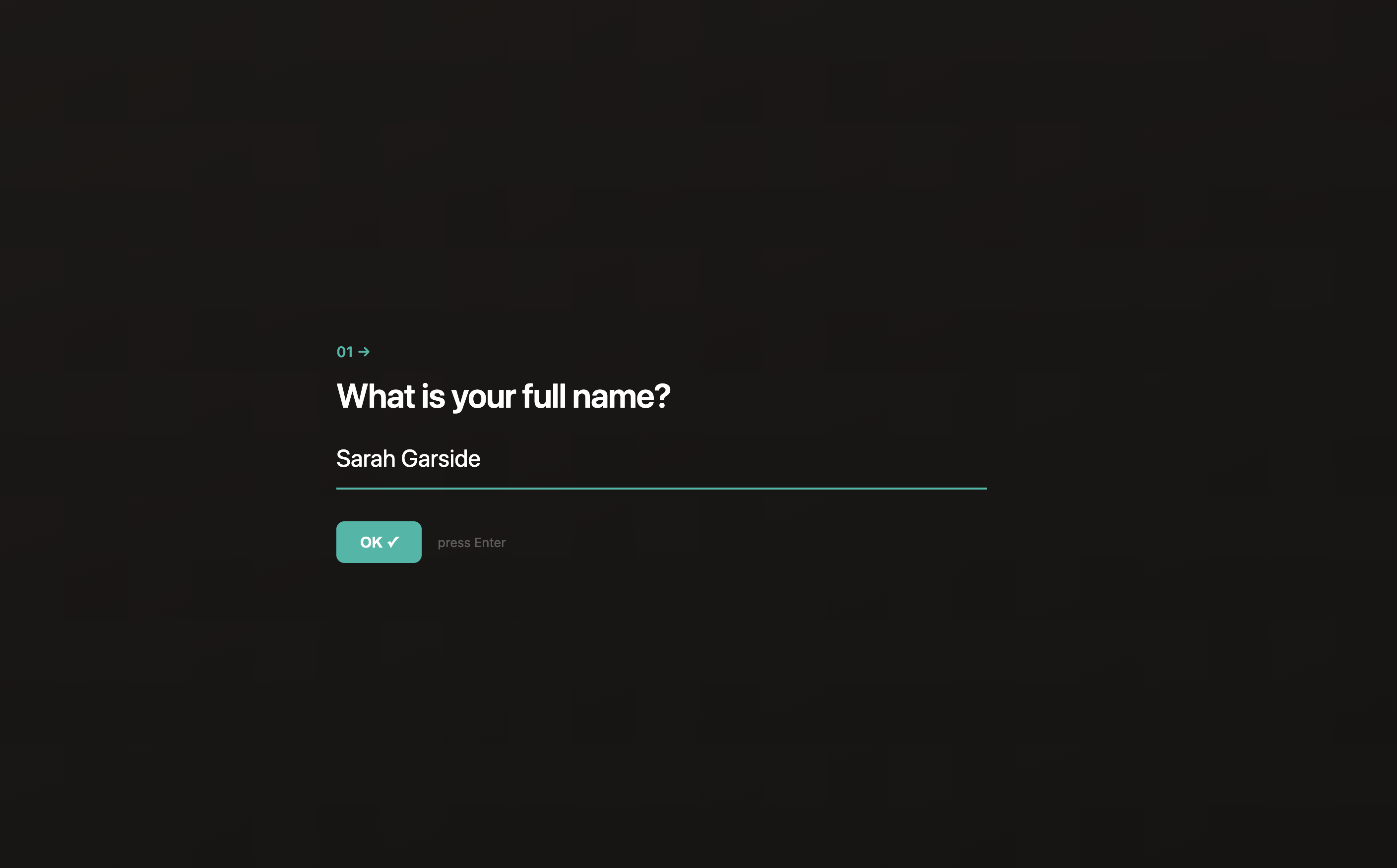
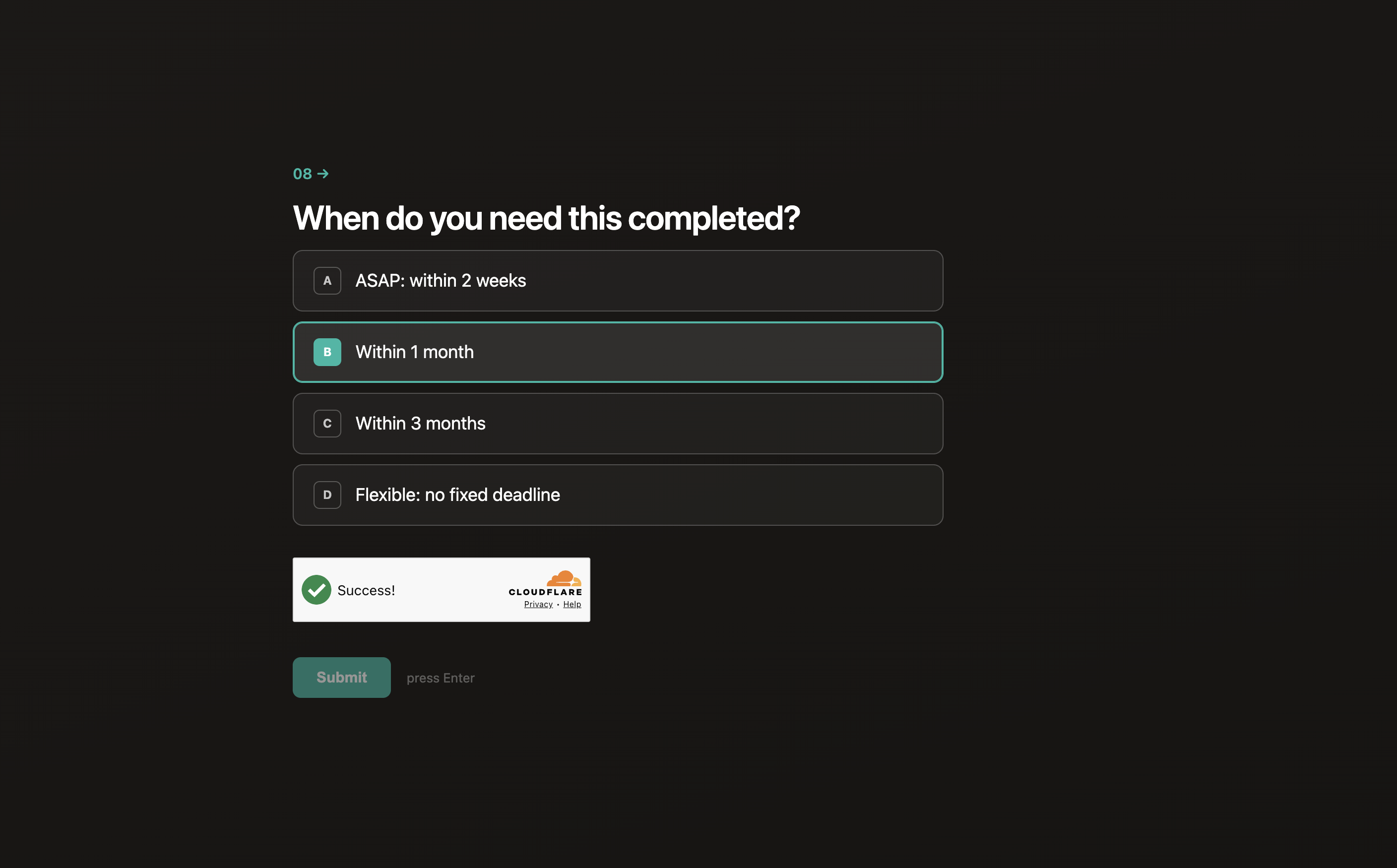
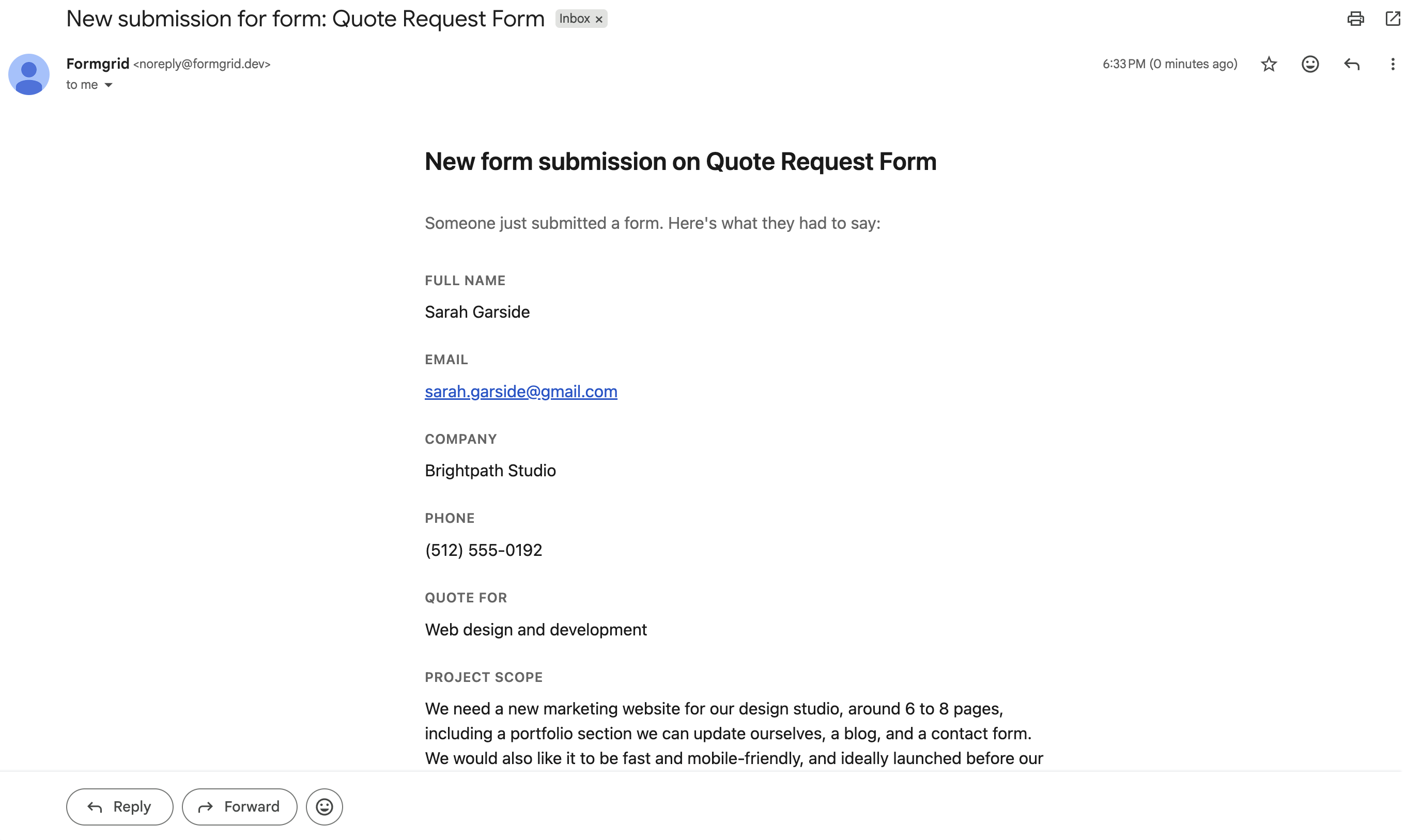
The email includes every field the respondent submitted, formatted so you can scan it in a few seconds, along with the time it was submitted.
If you are on the Business plan, these notification emails are sent from your own custom domain instead of a formgrid.dev address, so they land in your client's inbox looking like they came directly from you.
Step 8: Work the lead, not just the submission
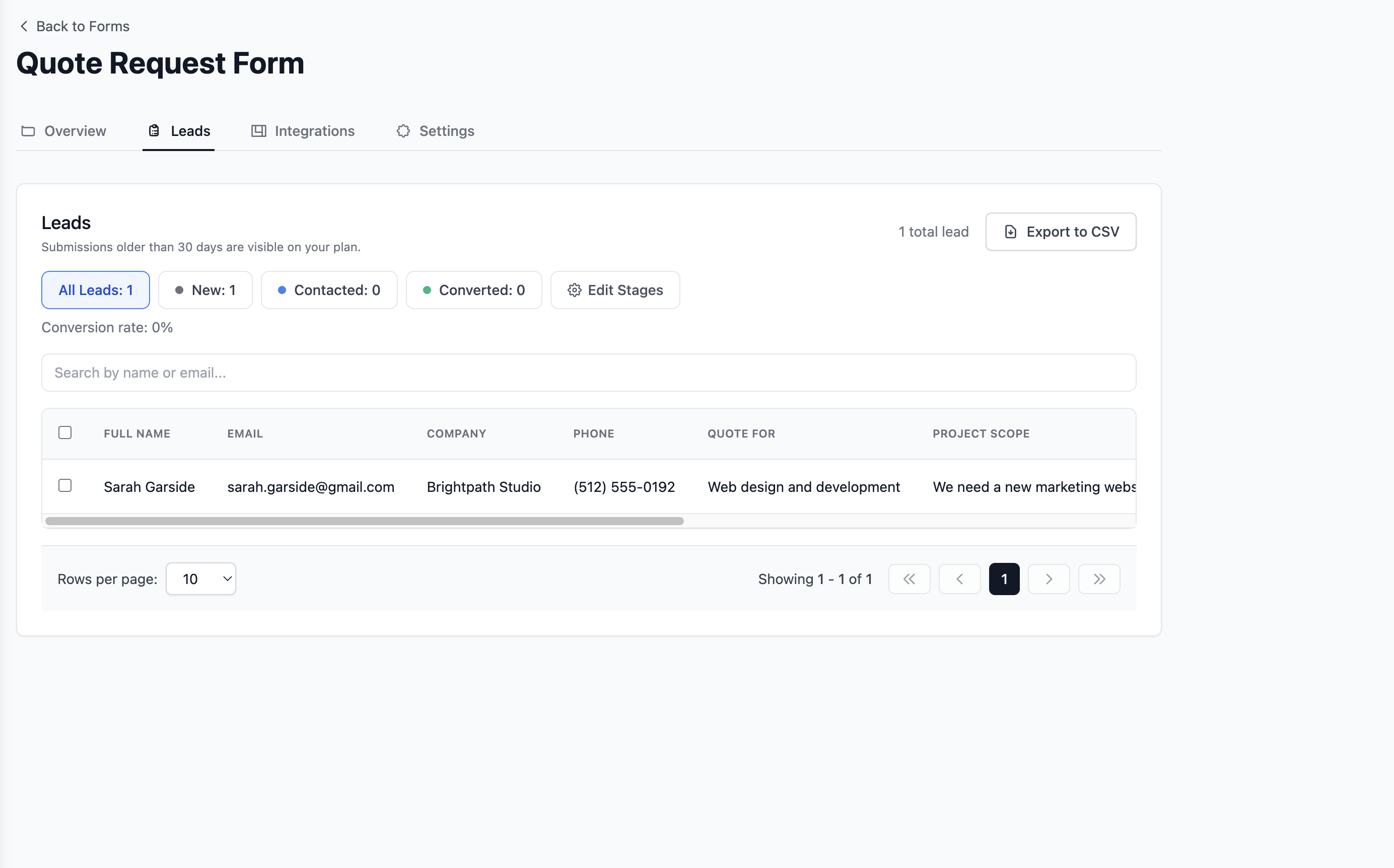
All submissions are stored in your Formgrid dashboard as leads, not just a static list. Go to the Submissions tab to view, search, filter, and export your data as a CSV, or open any individual lead to add a note, set a follow-up reminder, and update its status as you work it.
Replace Typeform now. No credit card required, and you will have this exact form live in under two minutes.
This is where Formgrid goes beyond every other tool on this list, including Typeform
Most form tools treat every submission the same way. It arrives, you get an email, that is it. There is no record of whether you followed up, whether the person became a customer, or what happened after they submitted. Formgrid turns every submission into a tracked lead automatically, moving through New, Contacted, and Converted.
Here is what the full flow looks like from form submission to tracked lead:
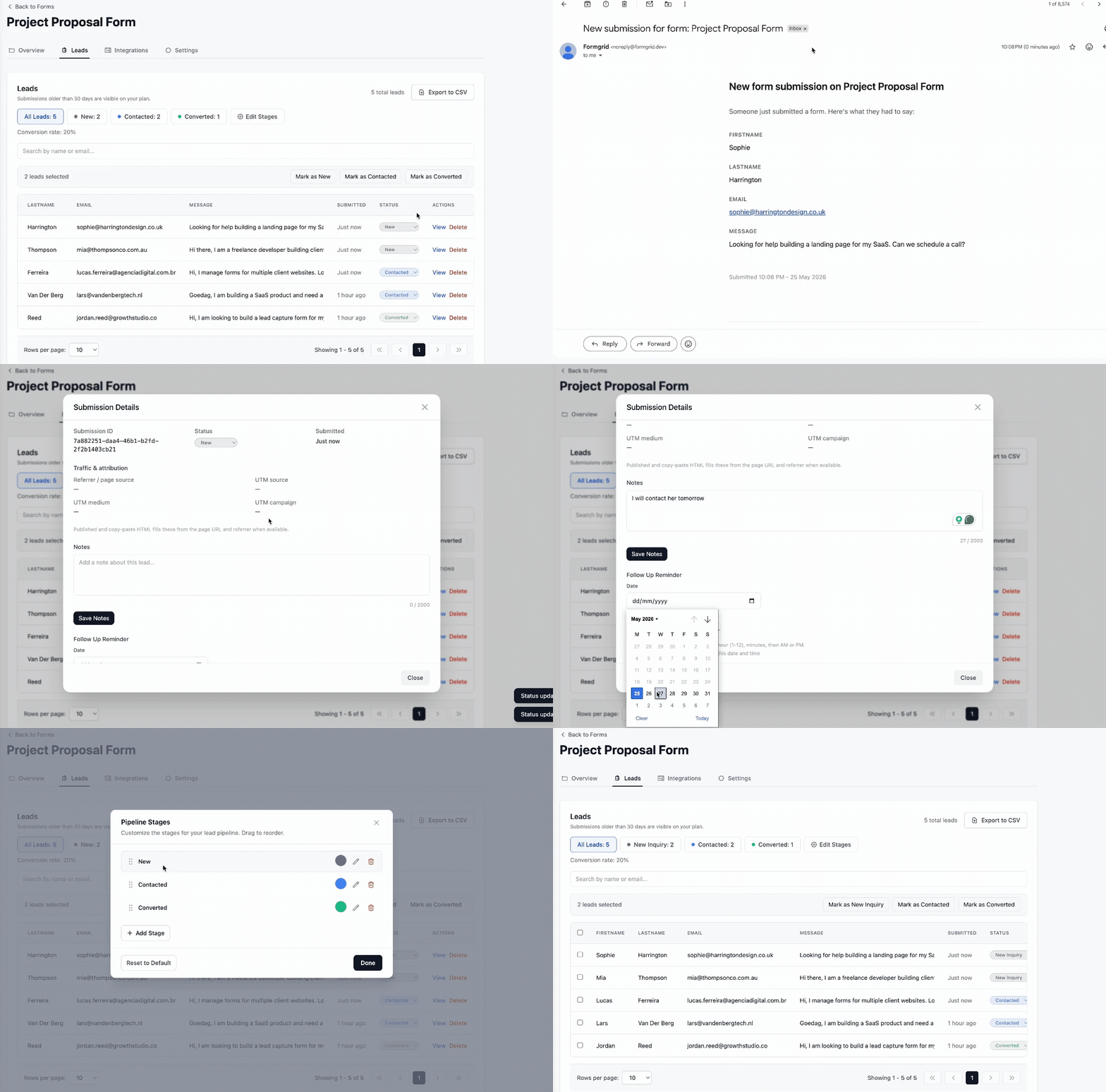
After every conversation, add a private note directly on the lead: what they said, what you quoted, what the next step is.
Called Thursday. Interested in a full website redesign.
Waiting on her final say on budget tier.
Follow up after the 15th.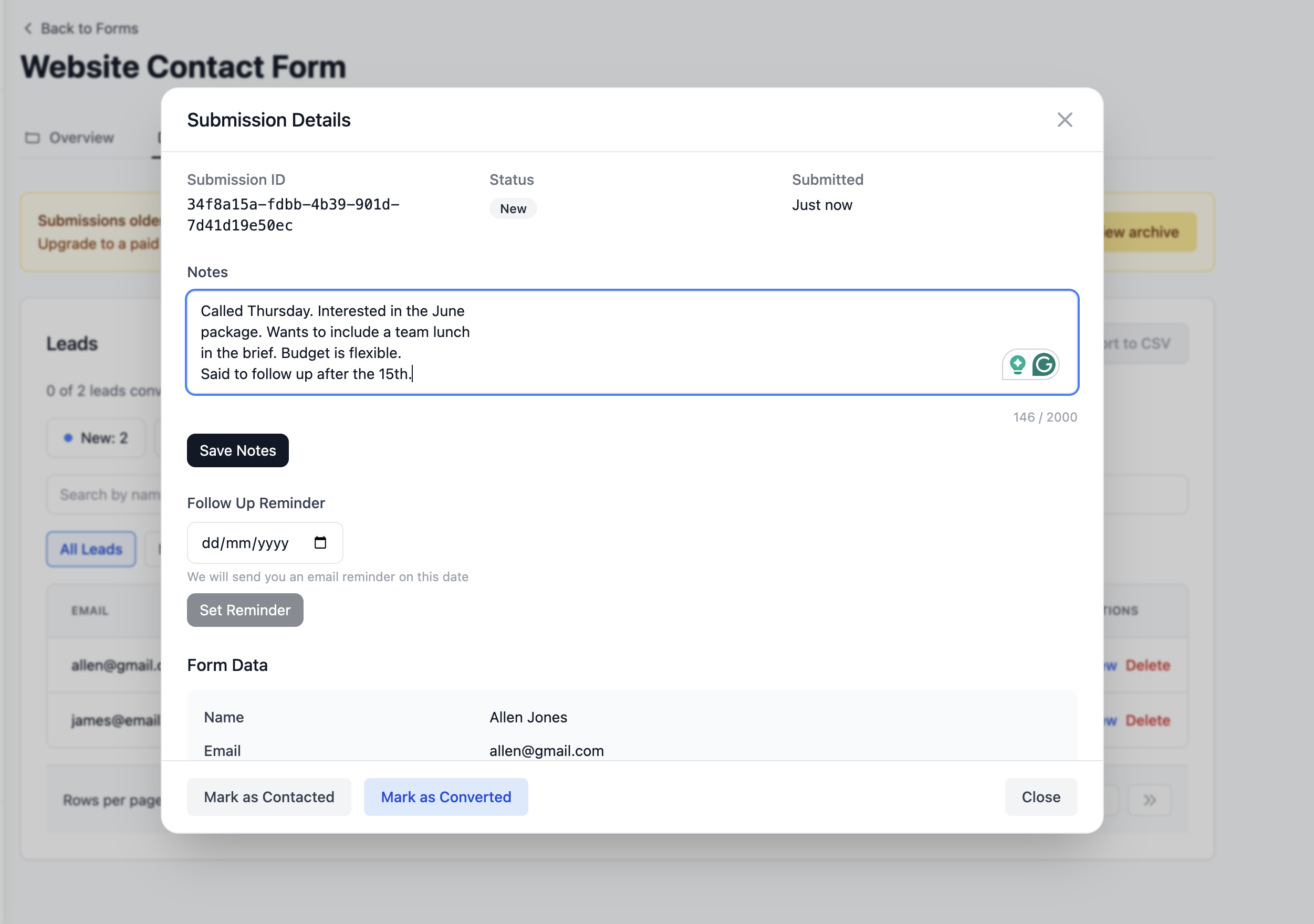
The next time you open that lead, your note is right there. You know exactly where the conversation left off before you pick up the phone.
When someone asks you to follow up in two weeks, set a reminder directly on the lead. Pick a date, click Set Reminder.
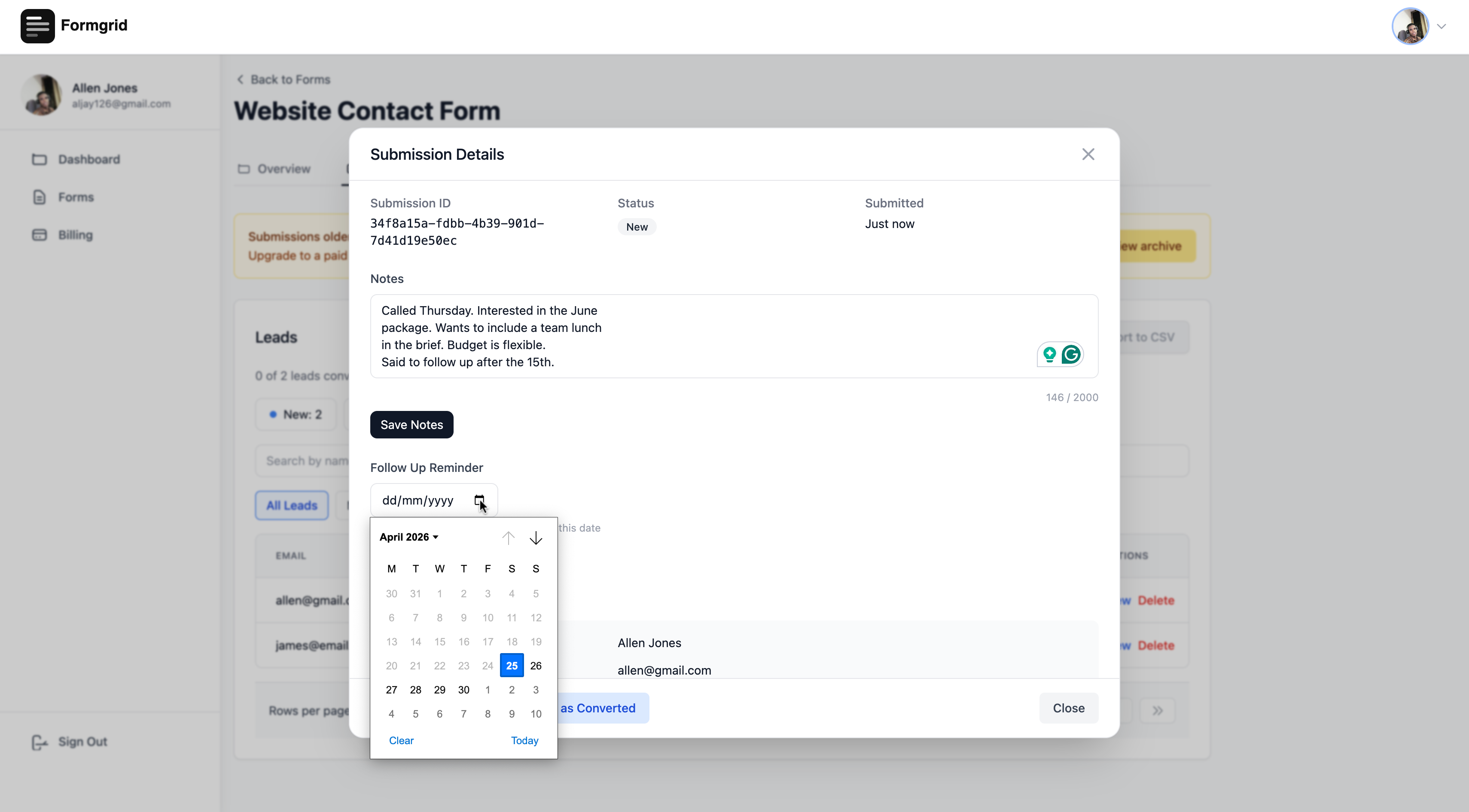
On that date, Formgrid emails you with the lead details and your notes so you have everything you need before you follow up.
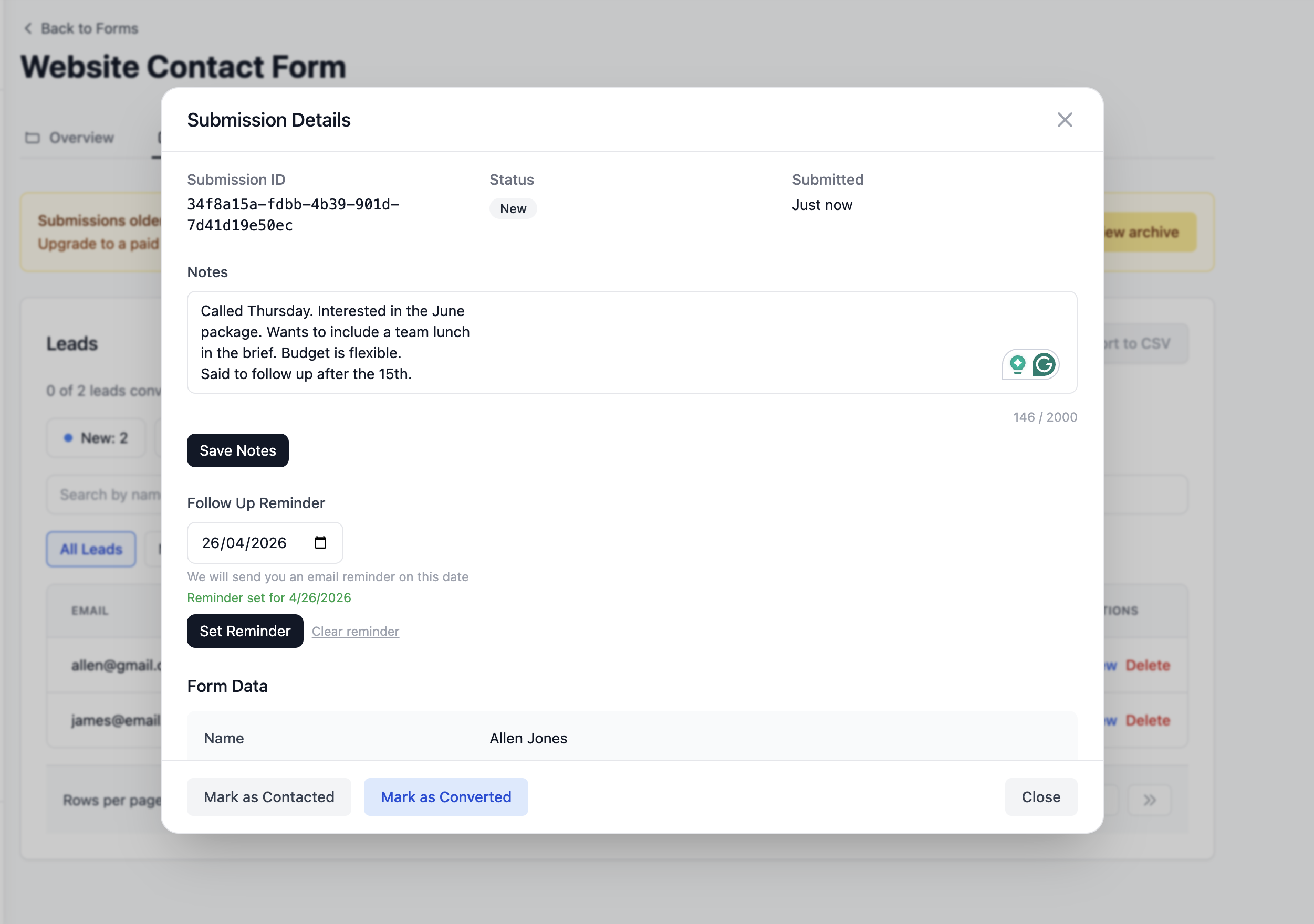
You set the reminder once. Formgrid handles the rest. No calendar invite, no sticky note, no hoping you remember, just an email at the right moment with everything you need.
As you move leads through the pipeline, your conversion rate updates automatically. That number tells you things a flat submissions list never could. If it drops, something has changed: maybe a new traffic source is bringing lower-quality leads, maybe you are taking too long to reply. If it is climbing, your process is working. Without that number, you are guessing.
Typeform, Google Forms, Tally, and Jotform all collect submissions. None of them tells you what happened after. Formgrid does.
See what a tracked lead looks like, try Formgrid free. No credit card required.
Sync to Google Sheets automatically
Every submission can automatically appear as a new row in your Google Sheet. No Zapier needed, no API setup. Connect your sheet once and every submission syncs instantly. Typeform charges extra for Google Sheets integration on paid plans.
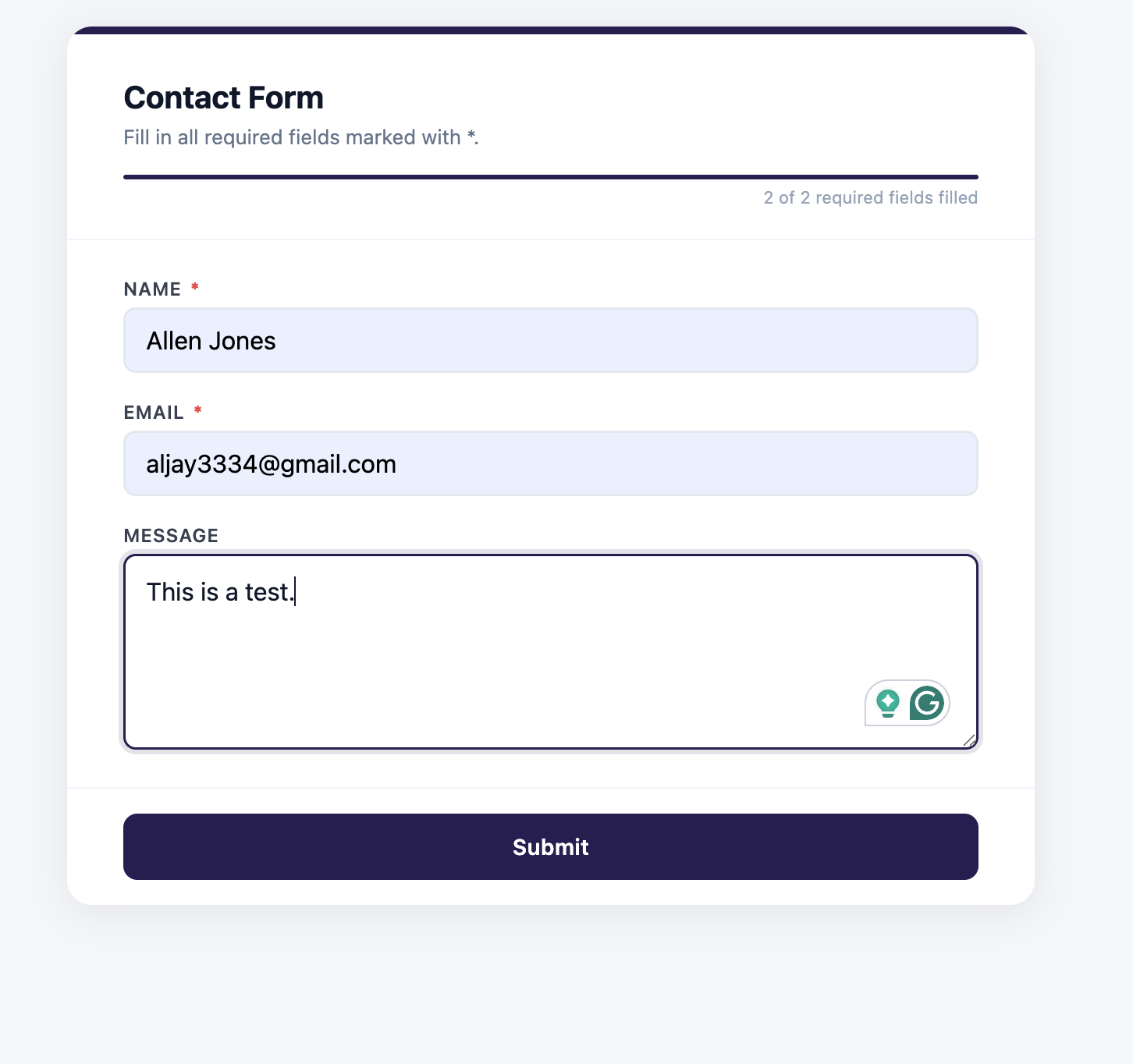
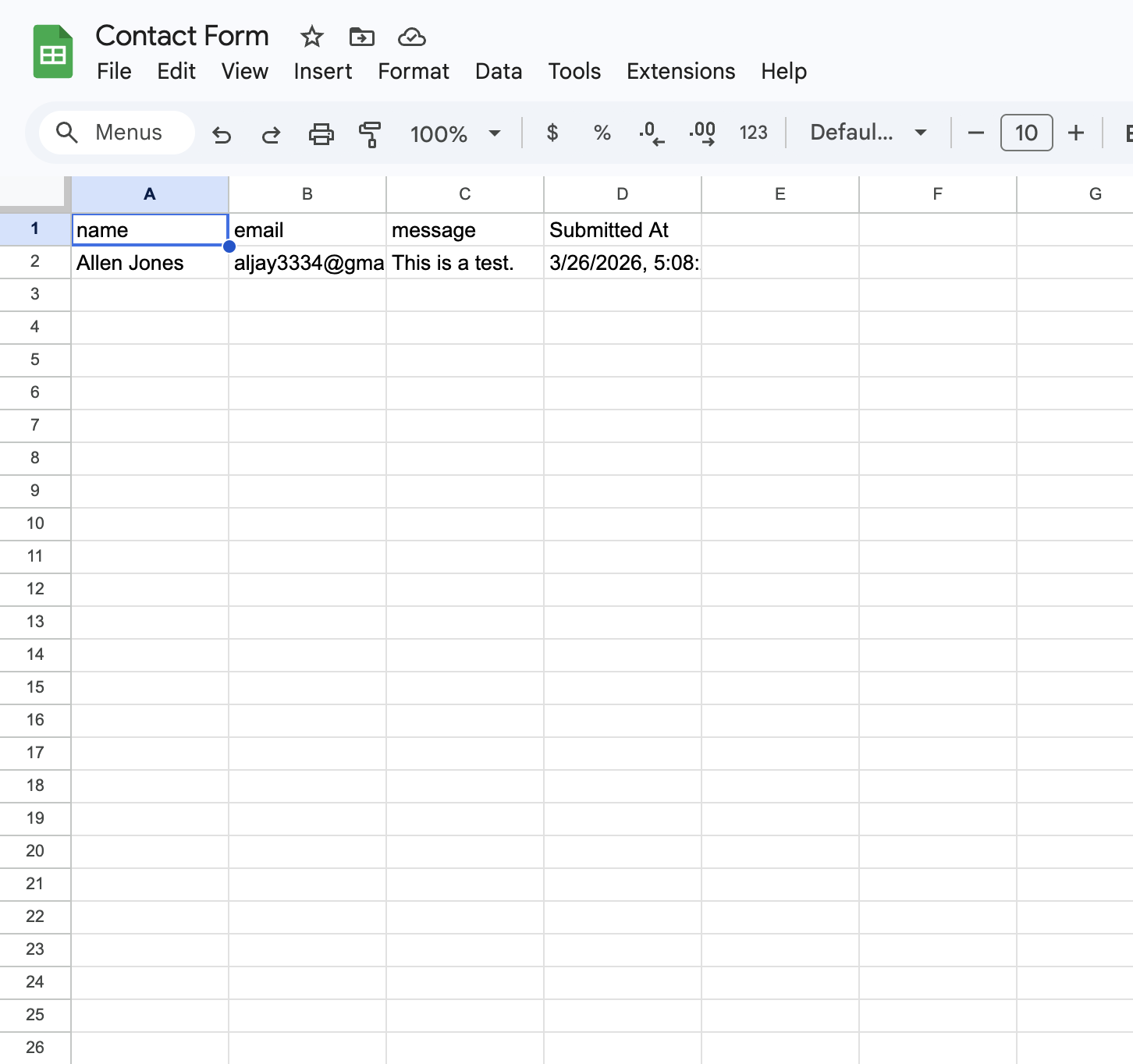
Turn your submissions into tracked leads. No credit card required.
Key features
- Multi-step conversational forms built in, no Typeform needed
- Landing page templates for different industries
- Try before you sign up: templates open in an anonymous builder so you can customize before creating an account
- Drag and drop form builder with shareable link
- HTML form endpoint for static sites
- Built-in lead pipeline: New, Contacted, Converted
- Notes and follow-up reminders on every lead
- Conversion rate tracking
- Free captcha and bot protection on all plans
- Instant email notifications
- File uploads from anyone without a Google account
- Google Sheets sync without Zapier
- CSV export
- Color picker for brand matching
- Auto-responder emails on Premium and Business plans
- Webhooks and Zapier on Business plan
- Self-hostable with Docker
- 100% open source under MIT license
- GDPR friendly with no tracking and no data selling
Pricing
| Plan | Price | Submissions |
|---|---|---|
| Free | $0/month | 50/month |
| Premium | $12/month | 1,000/month |
| Business | $29/month | 15,000/month |
The bottom line: Typeform charges $25 per month for a conversational form builder with a 10-response free plan, no HTML backend, no lead pipeline, and no bot protection. Formgrid gives you multi-step conversational forms, landing page templates, an HTML form backend, a full lead pipeline with follow-up reminders, free captcha protection, and Google Sheets sync for $12 per month.
If you are paying for Typeform right now, Formgrid is the obvious upgrade.
Try a template for free. No account needed to start customizing.
2. Google Forms: Best Free Typeform Alternative
Best for: anyone who needs a completely free form builder for basic use cases.
Unlimited responses at no cost make this a solid pick for basic surveys and internal data collection, but it has no custom branding, no lead management, no bot protection, and no HTML form backend.
Key features: completely free, unlimited responses, Google Sheets integration, conditional logic, simple analytics.
Pricing: free.
Tradeoff: no custom branding, no custom domain, no HTML form backend, no self-hosting, no bot protection, no lead management. Forms look like Google Forms, not like your brand.
3. Tally: Best Free Typeform Alternative for Non-Technical Users
Best for: non-technical users who want a Typeform-like experience at a lower price.
A clean, minimal form experience with unlimited responses on the free plan, but multi-step forms are only available on the paid plan at $29 per month, and there is no lead management or HTML form backend.
Key features: unlimited forms on the free plan, unlimited responses, conditional logic, file uploads on the paid plan, Notion integration, embeddable forms.
Pricing: free plan available, paid plan at $29 per month.
Tradeoff: no HTML form backend, no self-hosting, no open source, no bot protection, no lead management, multi-step forms locked to the paid plan.
4. Jotform: Best Typeform Alternative for Advanced Forms
Best for: businesses that need advanced form logic, payment integrations, and a full form management suite.
Strong for approval workflows, PDF generation, and payment collection, but it starts at $34 per month, has no HTML form backend, and no self-hosting.
Key features: thousands of templates, payment integrations including Stripe, PayPal, and Square, conditional logic, PDF generation, e-signatures, approval workflows.
Pricing: free plan available with 100 monthly responses, paid plans start at $34 per month.
Tradeoff: expensive at scale, no self-hosting, no open source, no HTML form backend, overkill for simple contact or quote request forms.
5. Paperform: Best Typeform Alternative for Beautiful Forms
Best for: marketers and creators who want visually striking forms with a strong brand feel.
A strong pick for landing page-style forms with payment support, but there is no free plan, no HTML form backend, and no lead management.
Key features: polished form design, payment integrations, conditional logic, calculator fields, media embedding.
Pricing: starts at $24 per month, no free plan.
Tradeoff: no free plan, no HTML form backend, no self-hosting, no open source, no lead management.
Side by Side Comparison
| Feature | Typeform | Formgrid | Google Forms | Tally | Jotform |
|---|---|---|---|---|---|
| Form builder | Yes | Yes | Yes | Yes | Yes |
| Multi-step forms | Yes | Yes | No | Paid | Yes |
| Conversational one question format | Paid | Free | No | Paid | No |
| Landing page templates | No | Yes | No | No | No |
| HTML endpoint | No | Yes | No | No | No |
| Lead pipeline | No | Yes | No | No | No |
| Notes on leads | No | Yes | No | No | No |
| Follow up reminders | No | Yes | No | No | No |
| Conversion tracking | No | Yes | No | No | No |
| Built in captcha | No | Free | No | No | Paid |
| Google Sheets sync | Paid | Yes | Yes | Paid | Paid |
| Shareable link | Yes | Yes | Yes | Yes | Yes |
| Self-hostable | No | Yes | No | No | No |
| Open source | No | Yes | No | No | No |
| Custom branding | Paid | Yes | No | Paid | Paid |
| File uploads | Paid | Yes | Yes | Paid | Paid |
| Free responses | 10/month | 50/month | Unlimited | Unlimited | 100/month |
| Starting price | $25/month | $12/month | Free | $29/month | $34/month |
| GDPR friendly | Partial | Yes | Partial | Partial | Partial |
Which One Should You Use?
Use Formgrid if you want multi-step or conversational forms without paying $25 a month for Typeform, you want a form builder with landing page templates that look like a real business page, you need to track what happens to submissions after they arrive, who you contacted, who converted, who needs a follow-up, you want to know your actual conversion rate from form to customer, you are getting spam and want free captcha protection without writing backend code, you want Google Sheets sync without paying extra or using Zapier, you need a form backend for your existing HTML site, or you care about open source and self-hosting.
Use Google Forms if you need something completely free with unlimited responses and branding or lead management does not matter.
Use Tally if you want a clean Typeform-like experience for free and do not need an HTML form backend or lead management.
Use Jotform if you need advanced logic, payments, approval workflows, and PDF generation, and budget is not a constraint.
Use Paperform if visual design is your top priority, you need strong payment integration, and you do not need an HTML form backend or lead management.
Final Thoughts
Formgrid is the strongest free alternative to Typeform here because it includes a multi-step conversational form builder, landing page templates, a full lead pipeline with follow-up reminders, free captcha protection, and Google Sheets sync at $12 per month compared to Typeform's $25 per month with none of those features.
Typeform built a beautiful product, but it is hard to justify the price in 2026 when better alternatives exist at a fraction of the cost. If you are paying for Typeform and not using its advanced branching logic, you are overpaying.
Browse templates and start building free. No account needed to try it.
Full disclosure: I built Formgrid. I wrote this comparison as honestly as I could. If anything looks inaccurate, let me know in the comments.

Comments
Leave a comment